Your CFO knows what you spend on rent. They know what you spend on salaries. They probably know what you spend on coffee.
But ask them what app sprawl costs per employee, and you'll get a blank stare.
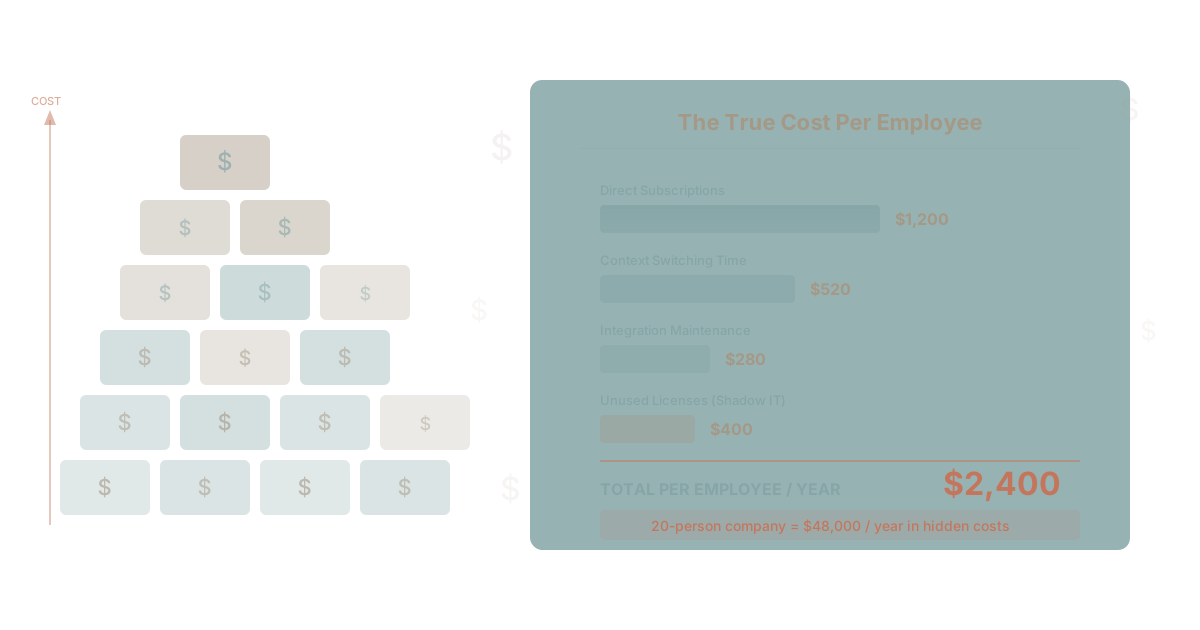
That's because the real cost of running 15-40 disconnected business applications isn't sitting in a single line item. It's spread across subscription invoices, wasted hours, duplicate data entry, and licenses nobody uses. When you add it all up, the number is $2,400 per employee per year — and for a 20-person company, that's $48,000 annually that nobody budgeted for.
Here's the math.
The Three Layers of App Sprawl Cost
Most businesses only see the first layer. The invoice that hits the credit card each month. But app sprawl costs compound across three distinct layers: direct, indirect, and hidden. Each one is bigger than you think.
Layer 1: Direct Subscription Costs
This is the number people actually track. It's also the smallest part of the problem.
According to Flexera's 2025 State of ITAM Report, the average company spends between $100 and $200 per employee per month on SaaS subscriptions. For a 20-person company using the conservative end, that's $24,000 per year just in software fees.
But here's what that looks like broken down:
| Category | Typical Tools | Monthly Cost Per User |
|---|---|---|
| Productivity Suite | Google Workspace or Microsoft 365 | $12-22 |
| Communication | Slack, Zoom, Teams | $15-25 |
| Project Management | Asana, Monday, ClickUp | $10-24 |
| CRM | HubSpot, Salesforce | $15-75 |
| Finance | QuickBooks, Xero | $5-15 |
| HR/People | BambooHR, Gusto | $8-15 |
| File Storage | Dropbox, Box | $12-20 |
| Security | 1Password, various | $5-10 |
| Industry-Specific | Varies widely | $10-50 |
Add it up across 15-25 applications and you land at $100-200 per employee per month. That's $1,200-2,400 per employee per year in direct costs alone.
For our calculation, we'll use the midpoint: $1,200 per employee per year in direct subscription costs.
That sounds manageable. It's the next two layers that make the number alarming.
Layer 2: Indirect Costs (The Time Tax)
Every application in your stack imposes a time tax on every person who touches it. This tax shows up in three ways.
Context Switching
This is the biggest one. Research from the University of California, Irvine found that it takes an average of 23 minutes and 15 seconds to fully refocus after switching between tasks or applications. Not 23 seconds. Twenty-three minutes.
Now consider how often your team switches apps. A study published by Harvard Business Review found that workers toggle between different apps and websites roughly 1,200 times per day. Even if we conservatively estimate just 10 meaningful context switches per day — the kind where someone has to leave one application, open another, find what they need, and refocus — that's:
- 10 switches x 23 minutes = 230 minutes of lost focus per day
- But not all switches require a full 23-minute recovery. Many are partial disruptions.
- Conservative estimate: 4 hours per week of productivity lost to context switching per employee
At an average fully loaded cost of $35/hour for a mid-market employee, that's $140/week, or roughly $520 per employee per year in context switching costs alone.
And that's the conservative number. McKinsey research suggests knowledge workers spend 28% of their workweek managing email and nearly 20% searching for information. Much of that searching happens because data is fragmented across too many tools — the exact problem that knowledge silos create.
Integration Maintenance
Somebody has to make all these apps talk to each other. Usually it's a combination of Zapier automations, API connections, middleware platforms, and manual workarounds.
For a 20-person company with 20 active integrations (a conservative estimate when you count email-to-CRM syncs, project-to-Slack notifications, form-to-spreadsheet pipelines, and calendar integrations):
- Zapier or equivalent: $50-100/month
- Time spent maintaining integrations: 5-10 hours/month at $50/hour
- Time spent fixing broken integrations: 3-5 hours/month at $50/hour
Total integration overhead: roughly $280 per employee per year when distributed across the team.
This is the integration tax that nobody accounts for. Every new tool you add doesn't just add its own subscription cost — it adds integration cost with every other tool it needs to connect to.
Duplicate Data Entry
When your CRM doesn't talk to your project management tool, someone manually enters the same customer information twice. When your expense system doesn't talk to your accounting software, someone re-keys every receipt.
A study from IDC estimated that knowledge workers spend 2.5 hours per day searching for information. A meaningful chunk of that time is spent re-entering data that already exists somewhere else in the stack.
We'll fold this into the context switching estimate above, since the behaviours overlap.
Total indirect costs: approximately $800 per employee per year.
Layer 3: Hidden Costs (The Silent Drain)
These are the costs that never appear on any report because nobody is measuring them.
Unused Licenses
This is the most well-documented hidden cost. Gartner research consistently finds that 25-30% of SaaS licenses go unused in any given period. Flexera's data corroborates this, finding that organisations waste an average of 29% of their SaaS spend on unused or underutilised licenses.
For our 20-person company spending $24,000/year on subscriptions, that means $6,000-7,200 per year is paying for seats nobody sits in. That's $300-360 per employee per year in pure waste.
This happens because:
- Employees leave but their licenses aren't cancelled for months
- Trial subscriptions auto-renew without anyone noticing
- Department heads buy tools for the "whole team" but only three people use them
- Annual contracts lock in seat counts that no longer match headcount
A proper annual software audit catches this waste. Most companies never do one.
Shadow IT
Shadow IT is what happens when employees sign up for tools without going through procurement. They put it on a personal card or a department credit card, and IT never knows about it.
According to Gartner, for every sanctioned SaaS application, organisations have 3-4 unsanctioned ones in use. For a company that officially uses 20 tools, that could mean 60-80 additional tools operating in the shadows.
Not all of these cost money — many have free tiers. But the ones that do cost money add up quickly. More importantly, shadow IT creates:
- Security risk: Unsanctioned tools handling company data without IT oversight
- Compliance risk: Data stored in tools that haven't been vetted for regulatory compliance
- Duplication: Multiple teams paying for tools that solve the same problem
Conservative estimate for shadow IT costs: $100 per employee per year in direct spending, plus immeasurable risk exposure.
Total hidden costs: approximately $400 per employee per year.
The Full Picture: $2,400 Per Employee Per Year
| Cost Layer | Category | Per Employee / Year |
|---|---|---|
| Direct | SaaS Subscriptions | $1,200 |
| Indirect | Context Switching | $520 |
| Indirect | Integration Maintenance | $280 |
| Hidden | Unused Licenses | $300 |
| Hidden | Shadow IT | $100 |
| Total | $2,400 |
For a 20-person company, that's $48,000 per year in total app sprawl costs.
For a 50-person company, it's $120,000.
For a 100-person company, it's $240,000.
And these are conservative estimates. Other analyses put the number significantly higher. The article on tool sprawl killing productivity cites research suggesting the per-employee cost could exceed $4,800 when you include the full productivity impact.
Why Nobody Tracks This
The reason this $48,000 goes unnoticed in a 20-person company is structural. The costs are distributed across too many budgets and too many categories:
Subscriptions live in the IT budget, the marketing budget, the sales budget, and every department head's discretionary spend. No single person sees the total.
Time costs don't appear on any financial statement. You can't point to a line item that says "context switching waste: $10,400." It shows up as lower output, missed deadlines, and the vague sense that the team should be getting more done.
Unused licenses require an audit nobody has time to perform. The person who might notice — usually someone in finance or IT — is busy maintaining the very integrations that create the problem.
Shadow IT is invisible by definition. If leadership knew about it, it wouldn't be shadow IT.
This is why the CIO's guide to tool rationalisation recommends starting with visibility. You can't fix what you can't see. And most companies can't see their real software costs because the data is as fragmented as the tools themselves.
The Compound Effect Over Time
App sprawl doesn't stay at $2,400. It grows.
Every year, your team adds 2-4 new tools. Each tool adds its own subscription cost, integration cost, and cognitive overhead. Meanwhile, the old tools rarely get removed — they just accumulate, like sediment.
Over five years, a 20-person company that started with $48,000 in annual app sprawl costs could easily see that number climb to $70,000-80,000. That's the compound effect of business amnesia in financial form: your organisation forgets what tools it's paying for, why it started using them, and whether anyone still needs them.
This is also why point-solution consolidation fails. Replacing Slack with Teams, or Asana with Monday, doesn't reduce the number of applications. It just swaps one subscription for another while leaving the structural problem — too many disconnected tools — completely intact.
What Consolidation Actually Looks Like
The answer isn't "use fewer tools." It's "use fewer disconnected tools."
A unified productivity platform replaces multiple point solutions with a single integrated system. Instead of paying separately for project management, goal tracking, meeting agendas, knowledge management, team communication, and reporting — all of which need integrations between them — you get one platform where everything shares the same data layer.
The impact on each cost layer:
Direct costs drop 40-60%. Instead of 15-25 separate subscriptions, you pay for one platform that covers multiple capabilities. You still need specialised tools for specific functions (accounting, email marketing), but the core productivity stack collapses from 10-15 tools to 2-3.
Indirect costs drop 60-70%. When your goals, projects, tasks, meetings, and knowledge live in one system, context switching plummets. No more toggling between Asana for tasks, Notion for docs, Slack for messages, and Google Sheets for reporting. Integration maintenance drops to near zero because there's nothing to integrate — the data is already unified.
Hidden costs drop 50-60%. Fewer tools means fewer unused licenses. A single platform makes shadow IT less tempting because the official tool actually covers what people need. And a proper audit becomes trivial when you have one vendor instead of twenty.
Conservative consolidation savings for a 20-person company:
| Cost Layer | Before | After | Savings |
|---|---|---|---|
| Direct | $24,000 | $12,000 | $12,000 |
| Indirect | $16,000 | $5,000 | $11,000 |
| Hidden | $8,000 | $3,000 | $5,000 |
| Total | $48,000 | $20,000 | $28,000 |
That's $28,000 per year back in the budget — or reinvested in tools that actually generate value, like custom apps built for your specific workflows.
The Question You Should Be Asking
Most companies evaluate software by asking: "Does this tool solve this specific problem?"
The better question is: "What is the total cost of adding another disconnected application to our stack?"
Because the answer is never just the subscription price. It's the subscription plus the integration plus the context switching plus the unused licenses plus the shadow IT it encourages. It's $2,400 per employee per year, compounding annually, invisible on every financial report.
You wouldn't accept a $48,000 line item that nobody could justify. But that's exactly what app sprawl represents in a 20-person company — a cost that's real, measurable, and almost entirely avoidable.
The first step is seeing it. The second step is deciding you've paid it long enough.
If you want to understand where your company falls on the sprawl spectrum, start with the context engineering approach — give yourself the full picture before making decisions. Run the annual software audit checklist. Map your tools. Count the real cost.
Then decide whether $2,400 per employee is a price you're willing to keep paying.
Part of our guide to all-in-one business platforms.
About the Author

Stuart Leo
Stuart Leo founded Waymaker to solve a problem he kept seeing: businesses losing critical knowledge as they grow. He wrote Resolute to help leaders navigate change, lead with purpose, and build indestructible organizations. When he's not building software, he's enjoying the sand, surf, and open spaces of Australia.