On April 2, 1982, Argentine forces invaded the Falkland Islands. What followed would transform not just British military doctrine, but our fundamental understanding of how organizations make decisions under pressure.
The lessons learned 8,000 miles away in the South Atlantic have profound implications for something most business leaders never connect to military history: their software.
The Tidy Battlefield
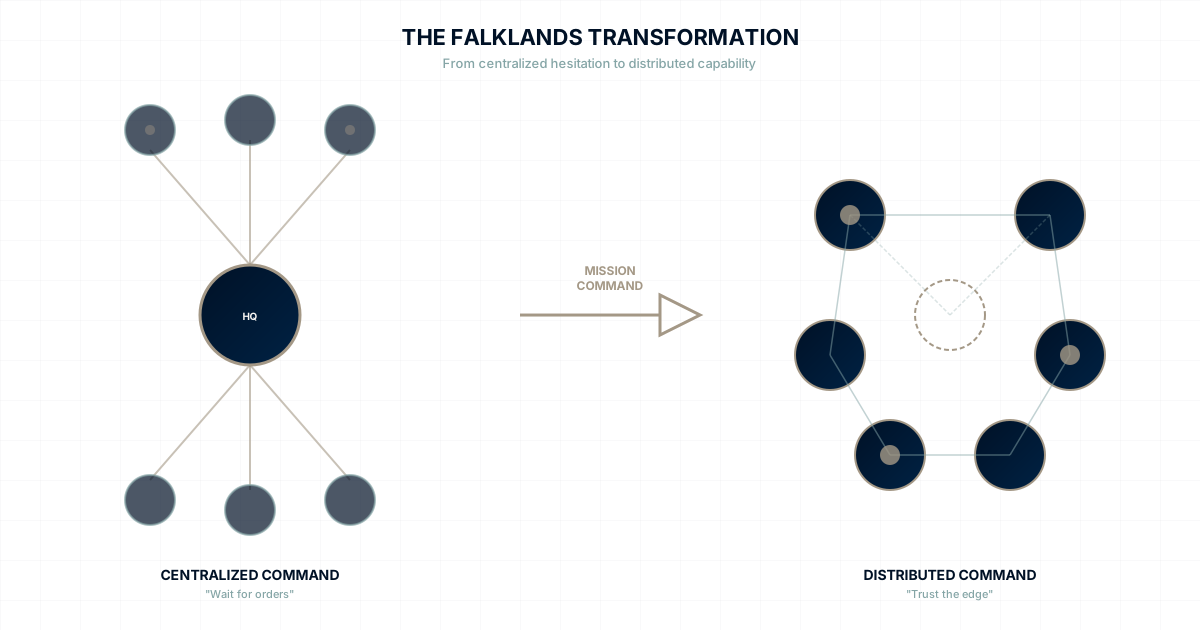
For decades before the Falklands, the British Army operated on principles refined during the Second World War. Field Marshal Bernard Montgomery famously called his approach "a tidy battlefield"—picturing military operations like an orchestra, with one conductor directing every instrument.
In Montgomery's model:
- Central command gathered intelligence from across the battlefield
- Headquarters analyzed and decided on the optimal course of action
- Orders flowed down through the chain of command
- Soldiers executed their specific assigned tasks
Every soldier understood their specific role within a strictly controlled framework. The system was orderly. It was hierarchical. It was, by Montgomery's standards, beautiful.
And it worked—in an era of slower communication, smaller battlefields, and more predictable enemies.
The Falklands Revelation
The Falklands War shattered assumptions that had held for forty years.
The conflict unfolded across treacherous terrain, 8,000 miles from headquarters, with communication delays measured in hours rather than seconds. Conditions on the ground changed faster than information could travel up the command chain, be processed, and return as orders.
But the technology gap wasn't the real problem.
The real problem was human.
British forces discovered that soldiers frequently hesitated—waiting for explicit orders from superiors even when acting independently could have avoided casualties. Commanders on the ground, capable and trained, paused at moments when initiative could have saved lives.
They weren't incompetent. They weren't cowardly. They were operating exactly as the system had taught them: wait for orders, follow the hierarchy, trust that headquarters knew best.
The system had conditioned them to depend on central command. When central command couldn't respond fast enough, the system failed.
The Cost of Hesitation
The inquiry into Falklands operations identified this pattern repeatedly:
- Soldiers with clear line-of-sight to threats waited for fire authorization
- Commanders with local intelligence deferred to headquarters assessments
- Opportunities for tactical advantage passed while approval requests traveled up and down the chain
- In some cases, casualties occurred that independent action could have prevented
The problem wasn't discipline. The problem was a doctrine that made independent action feel like insubordination.
Mission Command: The Revolutionary Response
The British Military's response was genuinely revolutionary: a doctrine called Mission Command.
The core principle was elegantly simple: push planning to the edge.
Instead of giving soldiers specific tasks within a centrally-controlled plan, Mission Command trained leaders at every level to understand strategic intent and make autonomous decisions aligned with that intent.
The Five Transformation Outcomes
Mission Command produced five documented transformation outcomes:
1. Leaders connected around aligned outcomes Instead of following task lists, commanders at every level understood the "why" behind operations. A patrol leader knew not just their route, but how that patrol supported larger objectives.
2. Purpose and direction clarified The British Military developed the 7 Questions for Combat Estimates—a systematic approach to battle planning ensuring every commander could answer the same strategic questions about their mission. This Socratic method transformed how decisions were made at every level.
3. Trust and authenticity increased By explicitly trusting commanders to make decisions, the system created genuine accountability. People who are trusted with authority take ownership in ways that followers of orders never do.
4. Speed and volume of collaboration accelerated Decisions that previously required headquarters approval could be made on the ground. The OODA loop (Observe, Orient, Decide, Act) tightened dramatically.
5. Decision-making decentralized The right decisions happened at the right level. Strategic decisions stayed with senior commanders. Tactical decisions moved to where the information was freshest.
Not Chaos—Distributed Capability
Mission Command didn't create chaos. It created capability.
The key insight was that you could have both autonomy AND alignment. Commanders at the edge had freedom to decide, but they decided within a framework of shared understanding about objectives, constraints, and values.
The orchestra didn't disappear. But instead of one conductor controlling every note, each section learned to lead themselves while playing the same symphony.
From Battle Planning to Business Leadership
Years later, I saw the same principles could transform how businesses operate. The British Military's 7 Questions for Combat Estimates became the foundation for what I developed as the 7 Questions of Leadership—adapting the Socratic method from the battlefield to the boardroom.
The framework became central to the Resolute Leadership Curve, taught to hundreds of business leaders across industries. The same systematic approach that helps commanders coordinate under pressure helps leadership teams align around strategy, purpose, and execution.
The lineage is clear:
- Military: 7 Questions for Combat Estimates (battle planning)
- Business: 7 Questions of Leadership (organizational strategy)
- Software: Operations at the Edge (workspace sovereignty)
The Business Software Parallel
After teaching the 7 Questions framework to hundreds of business leaders over the years, I kept encountering a pattern.
Organizations would complete strategic planning. They'd develop clear vision, articulate values, define their mission. Leaders would leave workshops energized and aligned.
Then they'd return to their offices. And the alignment would fracture within weeks.
Not because the strategy failed. But because their software enforced the old model.
Central IT: Montgomery's Approach to Software
Consider how most businesses operate today:
- IT controls what tools each department can access
- Headquarters approves software purchases and configurations
- Teams submit requests for the capabilities they need
- Central administrators decide what gets provisioned and when
This is Montgomery's tidy battlefield, implemented in Jira tickets and approval workflows.
And it produces the same problem the Falklands exposed: capable people hesitating, waiting for permission, while opportunities pass.
The Modern Hesitation
The business equivalent of soldiers waiting for fire authorization:
- Marketing can't launch a campaign because email automation isn't provisioned
- Sales can't track a new opportunity type because CRM modifications require IT approval
- Operations can't measure a critical metric because analytics dashboards need development
- Customer service can't implement a workflow improvement because process changes need sign-off
Every team is trained to wait. And while they wait, the market moves.
Operations at the Edge: Mission Command for Software
If Mission Command pushed planning to the edge, what if we pushed operations to the edge?
This is the founding principle of WaymakerOS: the people doing the work should have the tools to do the work.
Workspace Sovereignty
Instead of central IT controlling all tool access, each workspace operates as a self-contained unit with sovereignty over its tools:
- Marketing can deploy email journeys, forms, and automations without tickets
- Sales can build custom pipeline tables and reporting without waiting
- Operations can create tracking systems and automations immediately
- Customer service can implement workflow improvements on their own timeline
Unified Data, Distributed Capability
The key is that autonomy doesn't mean isolation.
Every workspace draws from the same organizational database. When marketing creates a contact, sales sees it. When operations updates a project, leadership dashboards reflect it. When customer service logs an interaction, the full customer history is available everywhere.
This is the Mission Command insight applied to software: autonomy AND alignment.
The Five Transformation Outcomes—Revisited
When organizations adopt Operations at the Edge, they experience the same transformations the British Military documented:
1. Leaders connect around outcomes, not tool requests IT conversations shift from "can we have access to X?" to "what are we trying to achieve?" Leaders focus on strategy because tactical tool decisions happen at the edge.
2. Purpose and direction clarify When every workspace has access to organizational goals and context, teams understand how their work connects to broader objectives. Alignment becomes structural, not just aspirational.
3. Trust and authenticity increase Workspace sovereignty sends an unmistakable message: we trust you to do your job. That trust creates ownership. Ownership drives accountability.
4. Speed and collaboration accelerate Without bottlenecks, teams move at the speed of need. Marketing launches when markets demand. Sales builds when opportunities arise. Nobody waits for permission.
5. Decision-making decentralizes appropriately Strategic decisions stay with leadership. Operational decisions move to where work happens. The organization becomes responsive without becoming chaotic.
The Falklands Lesson
The Falklands War taught the British Military that centralized command creates hesitation. People trained to wait for orders will wait, even when waiting costs lives.
The same principle applies to business software. People trained to submit IT tickets will wait, even when waiting costs opportunities, customers, and competitive advantage.
The solution is the same: trust the people closest to the action.
Give them the tools. Give them the authority. Give them the autonomy to do their jobs effectively.
This is Operations at the Edge. This is why WaymakerOS exists.
Continue the Journey
- Operations at the Edge: Why WaymakerOS Exists: The full philosophy
- Why Your Teams Are Waiting for IT: The HQ bottleneck in detail
- Workspace Sovereignty: What autonomous workspaces look like
- Central Control vs. Operations at the Edge: Direct comparison with Microsoft and Google
WaymakerOS. The way to make your business OS. Make the way.
The people doing the work have the tools to do the work.
Experience workspace sovereignty with Commander.
About the Author

Stuart Leo
Stuart Leo founded Waymaker to solve a problem he kept seeing: businesses losing critical knowledge as they grow. He wrote Resolute to help leaders navigate change, lead with purpose, and build indestructible organizations. When he's not building software, he's enjoying the sand, surf, and open spaces of Australia.