In 2011, there were roughly 150 marketing technology vendors.
Today there are over 14,000 products from 5,000+ vendors—and that's just marketing.
How did we get here? And why does it matter for your organization?
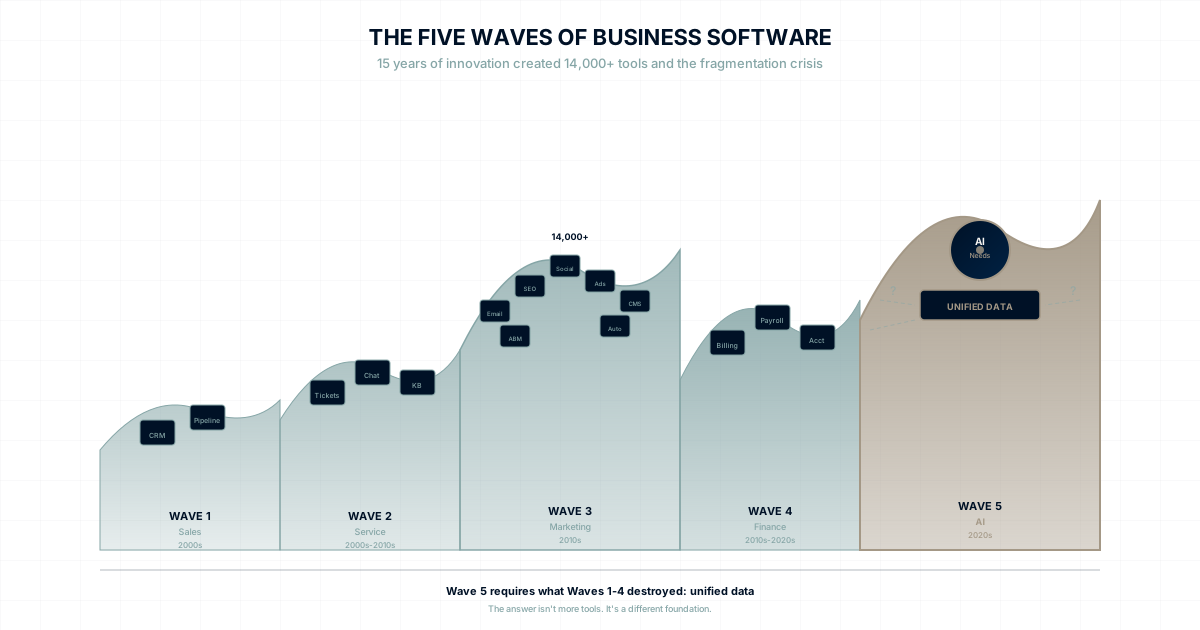
The answer lies in understanding five distinct waves of business software innovation. Each wave solved genuine problems. Each wave created new categories of tools. And together, they created the fragmentation crisis that now threatens organizational effectiveness.
The fifth wave—AI—requires what waves one through four destroyed: unified data.
This is the story of how we got here, and why understanding it matters for what comes next.
Wave One: Sales (2000s)
The Problem It Solved
Before CRM, sales was chaos. Leads lived in spreadsheets. Customer history existed in email threads and sticky notes. When a salesperson left, their relationships walked out the door with them.
Organizations had no visibility into their pipeline. Forecasting was guesswork. Sales managers couldn't see what their teams were doing until deals closed—or didn't.
The Wave
Salesforce launched in 1999 with a radical idea: sales management in the cloud. No servers to install. No software to maintain. Just log in and track your deals.
The CRM wave followed:
- Pipeline management replaced spreadsheet chaos
- Contact databases captured customer relationships
- Forecasting tools brought visibility to revenue
- Sales automation systematized follow-ups
By the mid-2000s, every serious sales organization had a CRM. The market exploded with options: Salesforce, HubSpot, Pipedrive, Zoho, Microsoft Dynamics, and hundreds more.
What It Created
Sales got its own software stack. But that stack didn't talk to anything else.
Marketing generated leads that had to be manually imported. Customer service couldn't see sales history. Finance had no visibility into pipeline for revenue planning. The sales database became its own silo.
Wave One created the first organizational data island.
Wave Two: Service (2000s-2010s)
The Problem It Solved
Customer support was drowning in email. Support requests came through phone, email, and eventually chat—with no unified view of customer issues. Agents couldn't see previous interactions. Customers repeated themselves endlessly. Response times stretched to days.
Organizations had no way to measure support quality. Tickets fell through cracks. Customer satisfaction was unmeasurable.
The Wave
Zendesk launched in 2007, pioneering cloud-based help desk software. The service wave followed:
- Ticketing systems organized support requests
- Knowledge bases enabled self-service
- Chat tools added real-time support
- Customer satisfaction surveys measured quality
- SLA tracking held teams accountable
The market exploded: Zendesk, Freshdesk, Intercom, Help Scout, ServiceNow, and hundreds of specialized tools for different support use cases.
What It Created
Service teams got their own software stack. But it didn't connect to sales or marketing.
When a high-value prospect submitted a support ticket, sales didn't know. When a customer complained repeatedly, marketing kept sending them promotional emails. When service resolved an issue, there was no feedback loop to product.
Wave Two created the second data island—now sales and service operated in parallel silos.
Wave Three: Marketing (2010s)
The Problem It Solved
Marketing was flying blind. Campaigns launched with no way to measure results. Attribution was impossible. "Half my marketing budget is wasted—I just don't know which half" was accepted wisdom.
Digital channels multiplied: email, social, search, display, content, video. Each channel needed its own tools. Each tool generated its own data. Marketers needed help managing the complexity.
The Wave
This is where the explosion happened.
Scott Brinker's Marketing Technology Landscape tracked the growth:
| Year | MarTech Vendors |
|---|---|
| 2011 | ~150 |
| 2014 | ~1,000 |
| 2017 | ~5,000 |
| 2020 | ~8,000 |
| 2024 | ~14,000 |
Every marketing function got its own category:
- Email marketing: Mailchimp, Constant Contact, SendGrid
- Marketing automation: Marketo, Pardot, ActiveCampaign
- Social media: Hootsuite, Sprout Social, Buffer
- SEO tools: Moz, Ahrefs, SEMrush
- Analytics: Google Analytics, Mixpanel, Amplitude
- Advertising: Google Ads, Meta Ads, programmatic platforms
- Content management: WordPress, Contentful, Webflow
- Landing pages: Unbounce, Leadpages, Instapage
- ABM platforms: Demandbase, 6sense, Terminus
And within each category, dozens of specialized tools for specific use cases.
What It Created
Marketing became the most fragmented function in the organization.
The average marketing team now uses 12-15 different tools. Each tool has its own data. Customer journeys span multiple systems with no unified view.
Marketing data doesn't connect to sales data. Lead scoring happens in isolation. Campaign attribution requires expensive integration work. Customer profiles exist in fragments across a dozen databases.
Wave Three didn't just create another data island—it created an archipelago.
Wave Four: Finance (2010s-2020s)
The Problem It Solved
Finance was stuck in the past. Accounting software was desktop-bound. Billing was manual. Expense reports meant paper receipts. Financial planning happened in spreadsheets that took weeks to update.
Growing businesses needed finance tools that could scale. Subscription businesses needed billing systems that could handle recurring revenue. Remote work needed expense management that didn't require physical paperwork.
The Wave
The fintech revolution brought cloud-native finance:
- Accounting: Xero, QuickBooks Online, FreshBooks
- Billing: Stripe, Chargebee, Recurly
- Expense management: Expensify, Brex, Ramp
- Payroll: Gusto, Rippling, Deel
- Financial planning: Anaplan, Adaptive Insights, Pigment
- Procurement: Coupa, Zip, Airbase
Each function got specialized tools. Each tool optimized for its specific use case. Each tool created its own data silo.
What It Created
Finance now operates with its own fragmented stack.
Billing data doesn't automatically reconcile with accounting. Expense data requires manual categorization. Revenue recognition spans multiple systems. Financial planning pulls from dozens of sources with manual data preparation.
Wave Four added financial data islands to the growing archipelago.
The State After Four Waves
By 2020, the average mid-market company managed 15-20 different software tools. Enterprise companies often exceeded 100.
Each tool solved a real problem. Each tool delivered genuine value. And together, they created a new problem bigger than any they solved:
The Integration Tax
Organizations now spend $2M+ annually just connecting their tools. Integration platforms like Zapier, Workato, and MuleSoft became essential—adding another layer of cost and complexity.
Every new tool requires:
- Integration work to connect it
- Data mapping to align fields
- Workflow automation to sync processes
- Ongoing maintenance as tools update
The integration tax compounds with every tool added.
The Data Fragmentation Crisis
Customer data exists in fragments across:
- CRM (sales view)
- Help desk (support view)
- Marketing automation (campaign view)
- Email platform (communication view)
- Analytics (behavior view)
- Billing system (financial view)
No single system has a complete picture. "Single customer view" became a multi-million-dollar data warehousing project.
The Context Collapse
When data fragments, context collapses.
Marketing sends promotional emails to customers with open support tickets. Sales pitches products that customers already own. Service agents can't see the customer's full history. Every team operates with partial information, making decisions in the dark.
The Shadow IT Explosion
When approved tools don't meet needs and IT becomes a bottleneck, employees find workarounds. Shadow IT spending now exceeds official IT budgets at many organizations.
Teams sign up for tools with personal credit cards. Data flows through unauthorized channels. Security and compliance gaps multiply.
After four waves, organizations had more tools than ever—and less organizational coherence than before the tools existed.
Wave Five: AI (2020s)
The Problem It Wants to Solve
AI promises to transform everything. Automate repetitive work. Generate content. Analyze data at scale. Predict outcomes. Assist decision-making.
The potential is genuine. AI can process information faster than humans. It can find patterns we miss. It can scale capabilities that previously required armies of people.
The Fundamental Requirement
But AI has a requirement that waves one through four made nearly impossible to meet:
AI needs unified data to work.
An AI that only sees sales data can't understand the full customer relationship. An AI that only sees marketing data can't predict revenue. An AI that only sees fragments delivers fragmented insights.
The promise of AI—understanding context, making connections, automating intelligently—requires exactly what the previous waves destroyed: a unified view of organizational information.
The Current Reality
Most AI implementations fail or underperform. According to Gartner, 85% of AI projects don't deliver expected value.
The reason isn't the AI technology. It's the data foundation.
Organizations try to bolt AI onto fragmented data:
- AI copilots that can only see one tool's data
- Chatbots that can't access customer history across systems
- Analytics that require manual data aggregation
- Automation that breaks when data doesn't sync
The fifth wave can't deliver on its promise while standing on the fragmented foundation of waves one through four.
What Wave Five Reveals
AI doesn't just need better tools. It needs a different foundation.
The organizations that will benefit most from AI aren't the ones with the most sophisticated AI tools. They're the ones with unified data that AI can actually use.
Wave Five reveals the true cost of waves one through four: an inability to benefit from the most transformative technology since the internet.
The Path Forward
Understanding the five waves reveals why incremental improvement won't work.
What Won't Solve It
More integration just adds complexity. Every new integration is another point of failure, another sync to maintain, another mapping to manage.
Better tools in each category perpetuates the fragmentation. A better CRM is still a CRM silo. A better marketing platform is still a marketing silo.
Data warehouses create yet another system. Now you have the original fragmented tools PLUS a warehouse that requires constant data engineering to keep current.
AI middleware tries to paper over fragmentation with intelligence. But AI built on fragmented data inherits fragmented understanding.
What Will Solve It
The answer isn't better tools within the fragmented architecture. It's a different architecture entirely.
Unified data by design: Instead of integrating separate databases, start with one organizational database that all functions share.
Workspace sovereignty: Instead of central IT controlling tool access, let workspaces deploy the capabilities they need—all drawing from unified data.
Operations at the edge: Instead of centralizing operations at HQ, push operational capability to where work happens—with platform governance ensuring security and compliance.
This is the foundation WaymakerOS is built on. Not another tool to add to your stack. A different approach to the stack itself.
The Lesson of Five Waves
Each wave of business software solved real problems. CRM brought visibility to sales. Help desks organized support. Marketing tools enabled measurement. Finance tools modernized accounting.
The problem wasn't any individual wave. The problem was the cumulative effect: five waves of innovation, each optimizing for its own function, creating an organization where no function can see the full picture.
The fifth wave—AI—exposes what was hidden: fragmented data doesn't just create inefficiency. It prevents organizations from benefiting from transformative technology.
The organizations that thrive in the AI era won't be those with the most tools. They'll be those that solved the foundation problem: unified data, distributed capability, operations at the edge.
Continue the Journey
Understand the fragmentation problem and its solution:
- Operations at the Edge: Why WaymakerOS Exists: The philosophy that addresses five waves of fragmentation
- The Computing History Parallel: Why technology always moves toward intelligent distribution
- SaaS Sprawl Is Killing Productivity: The daily cost of fragmentation
- The True Cost of 15 Business Apps: Quantifying the integration tax
WaymakerOS. The way to make your business OS. Make the way.
Not another wave. A different foundation.
Start with Commander and experience unified productivity.
About the Author

Stuart Leo
Stuart Leo founded Waymaker to solve a problem he kept seeing: businesses losing critical knowledge as they grow. He wrote Resolute to help leaders navigate change, lead with purpose, and build indestructible organizations. When he's not building software, he's enjoying the sand, surf, and open spaces of Australia.