Your app went viral. Your bill went nuclear.
It happens like this. You ship a product. A few hundred users try it. Costs are negligible. You optimise features, run campaigns, land a press mention. Traffic climbs. Then one morning you open your hosting dashboard and the invoice is four times what it was last month.
Nothing broke. Nothing was misconfigured. The platform worked exactly as designed. You just got charged for success.
This is the bandwidth metering trap, and it is the most underestimated cost in modern web hosting. It does not show up in "Getting Started" pricing pages. It does not trigger warnings until the bill has already landed. And it punishes the exact behaviour every founder is trying to achieve: growth.
How Bandwidth Metering Actually Works
Most serverless hosting platforms use a metered pricing model. You pay a base subscription for a generous-sounding allocation of bandwidth, compute, and storage. Beyond that allocation, every additional gigabyte and every additional function invocation costs money.
Vercel, for example, includes 1TB of bandwidth on their Pro plan. That sounds enormous. It is not.
Here is the arithmetic. A typical modern web page transfers 2-5MB of data per load. That includes JavaScript bundles, CSS, fonts, images, and API responses. At the conservative end -- 2MB per page view -- 1TB of bandwidth supports roughly 500,000 page views per month. At the heavier end -- 5MB per view, common for image-rich applications -- you are down to 200,000 page views.
For context, 200,000 page views per month is about 6,600 per day. That is not viral. That is a modestly successful B2B SaaS product with a few thousand monthly active users, each loading a handful of pages per session.
Once you exceed the allocation, Vercel charges $0.15 per additional gigabyte. On its own, that looks harmless. In aggregate, it compounds fast.
The Math at Different Scales
Here is what bandwidth metering looks like as a product grows, based on real cost modelling from a production application serving users across 55 countries.
| Monthly Active Users | Estimated Bandwidth | Vercel Estimated Cost | Flat-Rate Edge Cost |
|---|---|---|---|
| 1,000 MAU | 10-50 GB | $50-100/mo | $70-100/mo |
| 10,000 MAU | 100-500 GB | $200-500/mo | $100-150/mo |
| 50,000 MAU | 500 GB - 2.5 TB | $500-2,000/mo | $150-300/mo |
| 100,000+ MAU | 2-10 TB | $2,000-5,000/mo | $300-500/mo |
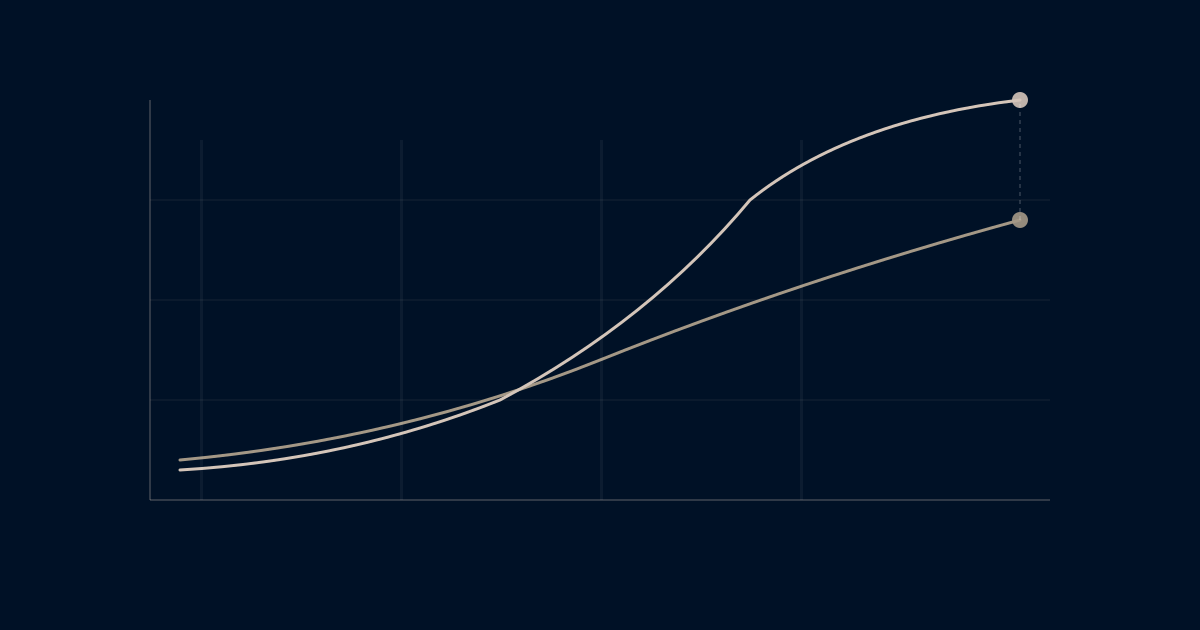
Look at the shape of that curve. At 1,000 MAU, the metered platform is comparable or even cheaper. At 10,000 MAU, the gap opens. By 50,000 MAU, you could be paying four to seven times more than a flat-rate alternative. At 100,000 MAU, the metered model costs up to $5,000 per month while the flat-rate model stays under $500.
The crossover point -- where metered hosting becomes more expensive than flat-rate edge hosting -- is around 10,000 to 20,000 monthly active users. For most growing products, that is not a distant future. That is twelve to eighteen months after a successful launch.
This is the paradox: at the scale where hosting costs do not matter, metered pricing is fine. At the scale where they do matter, metered pricing is punitive.
Why Image-Heavy and Media Apps Get Hit Hardest
Not all applications are equal under bandwidth metering. A lightweight SaaS dashboard with small API payloads and minimal images might average 1-2MB per page. An e-commerce platform with product galleries averages 3-5MB. A camera platform serving 24-megapixel stills and 4K video can push 10-50MB per interaction.
This is not theoretical. I recently modelled hosting costs for a construction camera platform with 5,600 cameras deployed across 55 countries. Their primary user interaction is viewing high-resolution site imagery -- stills at 24MP, time-lapse video at 4K. Every gallery view, every video playback, every thumbnail grid consumes bandwidth that the hosting provider meters and charges for.
For this type of application, the 1TB included bandwidth on a Vercel Pro plan could be consumed by a few hundred active users alone. The remaining bandwidth becomes the dominant line item on the hosting bill, growing linearly with every new customer.
Industries where this hits hardest:
- Construction and property tech -- site imagery, drone captures, progress photography
- E-commerce -- product images, zoom views, lifestyle photography
- Media and publishing -- article images, embedded video, rich content
- Healthcare -- medical imaging, scan viewing, patient portals
- Education -- video lectures, course materials, interactive content
- SaaS with dashboards -- charts, graphs, exported reports, data visualisations
If your product's core value involves showing users images, video, or data-rich interfaces, bandwidth metering is not a minor line item. It is the fastest-growing cost in your infrastructure.
The DDoS Billing Problem
Here is something most founders do not consider until it happens: metered hosting platforms have no hard spending limits.
If your application receives a traffic spike -- whether from a successful campaign, a press mention, a social media post, or a malicious DDoS attack -- the platform dutifully serves every request and charges you for the bandwidth.
Vercel does not offer spending caps that hard-stop serving when a threshold is reached. They offer spend management notifications, which alert you after the spend has occurred. By the time the notification arrives, the bill has already been incurred.
This is not a niche concern. In 2023, multiple developers reported receiving surprise Vercel bills ranging from several hundred to several thousand dollars from unexpected traffic spikes. The platform did exactly what it was supposed to do -- it scaled. But scaling on a metered model without spending limits means the cost scaled too, with no ceiling.
For a bootstrapped startup or a small team, a single traffic spike can create a hosting bill that exceeds an entire month's operating budget. The product did not break. The infrastructure worked perfectly. And that is the problem.
What Drives Costs Beyond Bandwidth
Bandwidth is the most visible metered cost, but it is not the only one. Modern serverless platforms meter several dimensions simultaneously:
Serverless function invocations. Every API call, every server-rendered page, every form submission triggers a function invocation. Vercel includes 1 million invocations on Pro, then charges $0.60 per additional million. A product with 50,000 MAU making 10 API calls per session generates 500,000 invocations per month -- approaching the limit from a single interaction pattern.
Edge middleware. If you use middleware for auth checks, redirects, A/B testing, or geolocation, every request passes through middleware before reaching your application. These are metered separately.
Image optimisation. Serving responsive images through the platform's optimisation layer incurs per-image charges. For image-heavy applications, this adds a meaningful surcharge on top of bandwidth.
Analytics and observability. Web analytics, speed insights, and log drains are either limited or charged as add-ons. The tools you need to understand why your bill increased are themselves billable.
Each of these individually looks reasonable. Combined, they create a cost structure where every dimension of growth -- more users, more page views, more API calls, more images -- triggers a separate billing meter. Your total hosting cost is not one number. It is the sum of five or six meters, all ticking upward together.
The Alternative Model: Flat-Rate Edge Hosting
Not every platform meters bandwidth. The large global edge networks -- the infrastructure layer behind a significant share of all websites -- operate on a fundamentally different model: unlimited bandwidth included.
Applications deployed on a global edge network -- across 300+ cities -- pay for compute and storage, not for data transfer. Whether your application serves 1GB or 100TB of bandwidth in a month, the bandwidth charge is zero.
This is not a promotional tier or an introductory offer. It is the architectural model. Edge networks make money from compute services, security products, and enterprise features. Bandwidth is included because charging for it would penalise the exact scale that makes the network valuable.
For products built on edge hosting platforms that use this model, the cost curve is fundamentally different. Growth in traffic does not trigger growth in bandwidth charges. Hosting costs scale with the number of applications and the compute resources they consume, not with how many users view them.
The practical difference at scale is stark. A platform serving 50,000 monthly active users on metered hosting might pay $500-2,000 per month. The same application on flat-rate edge hosting might pay $150-300. At 100,000 MAU, the gap widens to $2,000-5,000 versus $300-500.
That is not a rounding error. That is the difference between a product that is commercially viable and one that needs to raise prices or cut features to cover infrastructure costs.
How to Audit Your Own Hosting Costs
Whether or not you change platforms, understanding your actual cost structure is essential. Most teams have never calculated their per-user or per-page-view hosting cost. Here is how to do it.
Step 1: Calculate Your Effective Bandwidth Per User
Pull your total bandwidth from your hosting dashboard for the last three months. Divide by monthly active users. This gives you bandwidth per MAU.
If the number is above 50MB per user per month, your application is bandwidth-heavy. If it is above 200MB, bandwidth is almost certainly your largest cost driver.
Step 2: Project Forward
Take your growth rate (or target growth rate) and extrapolate bandwidth for the next 12 months. Then calculate the cost at your current platform's overage rate.
The question to answer: at what user count does bandwidth overage exceed your base subscription? That is your crossover point. Everything beyond it is pure scaling tax.
Step 3: Identify Your Metering Dimensions
List every metered dimension on your current platform:
- Bandwidth (GB)
- Serverless invocations (count)
- Edge middleware invocations (count)
- Image optimisations (count)
- Seats/developers (count)
- Analytics data points (count)
For each, calculate your current usage as a percentage of the included allocation. Any dimension above 60% will likely exceed its allocation within six months of growth.
Step 4: Model the Alternative
Price out your application on a flat-rate model. Include compute, storage, and any per-application fees. Compare the 12-month total cost at your projected growth rate.
If the flat-rate model saves more than 20% at your projected 12-month scale, it is worth evaluating a migration. If it saves more than 50%, the migration pays for itself in engineering time within a quarter.
What to Watch for in Hosting Pricing Pages
Hosting platforms have a financial incentive to make their pricing look simple at low volumes and to obscure the mechanics that drive cost at high volumes. Here are the signals to look for.
"Generous" included bandwidth. 100GB or 1TB sounds like a lot until you calculate how many page views it actually supports. Always convert bandwidth allocations into page views using your application's average page weight.
No hard spending limits. If the platform does not let you set a maximum monthly spend that stops serving traffic when reached, you have unlimited liability on every traffic spike. Ask explicitly: "Can I set a hard cap that prevents charges beyond $X?"
Overage rates buried in documentation. If the pricing page does not clearly state the per-GB overage rate, find it in the docs before signing up. The number you cannot find is usually the one that hurts.
Per-seat developer pricing. If your hosting platform charges per developer on your team, that cost scales with your engineering organisation, not your product usage. A 10-person team on Vercel Pro pays $200/month in seat fees before a single user visits the application.
Separate charges for table-stakes features. If analytics, monitoring, image optimisation, or custom domains are add-ons, calculate the real cost including every feature your production application requires.
The Architectural Decision
The choice between metered and flat-rate hosting is not just a cost decision. It is an architectural one.
On a metered platform, every engineering decision carries a billing implication. Adding a larger hero image increases bandwidth cost. Implementing server-side rendering increases function invocations. Adding real-time features increases middleware calls. The engineering team makes technical decisions with one eye on the invoice.
On a flat-rate platform, engineering decisions are made on technical merit. The better image serves the user. The server-rendered page improves SEO. The real-time feature improves the product. None of these choices increase the hosting bill.
This changes how teams build. It removes the invisible tax on product quality that metered billing imposes. Teams ship better products when they are not penalised for the traffic those products attract.
As a Cloudflare analysis noted, egress fees (the technical term for bandwidth charges) represent one of the largest markups in cloud infrastructure. The actual cost to serve a gigabyte of data is a fraction of what most platforms charge. Bandwidth metering is not a reflection of infrastructure cost. It is a pricing strategy that captures value from customer growth.
When to Make the Switch
You do not need to switch platforms today. If your product is early stage with under 5,000 monthly active users, the cost difference is negligible and stability matters more than optimisation.
But you should know your crossover point. And you should plan for it before you reach it, not after you receive the bill that tells you it already passed.
Monitor these triggers:
- Monthly hosting cost crosses $500. The cost differential between metered and flat-rate becomes material.
- Bandwidth exceeds 50% of your included allocation. You are six months from overage at current growth rates.
- You receive your first overage charge. The curve only steepens from here.
- You are building image-heavy or video-heavy features. Each new media feature accelerates bandwidth consumption.
- Your team hesitates on features because of cost implications. This is the moment metered billing starts degrading your product.
The migration itself is typically straightforward. Modern frontend applications are stateless by design -- the application logic lives in the code, the data lives in the database. Moving the hosting layer means redeploying code and updating DNS. For most applications, that is a one to two week engineering investment that pays for itself within a single billing cycle at scale.
The Bigger Picture
Hosting costs are one part of a larger pattern: the hidden scaling taxes embedded in modern SaaS infrastructure. Bandwidth metering is the most aggressive example, but per-seat pricing, compute metering, and feature-gated tiers all follow the same logic. They make early adoption painless and scale expensive.
The companies that build sustainably are the ones that understand their cost curves before they become constraints. They choose infrastructure with cost structures that reward growth rather than taxing it.
Your hosting bill should not double when your product succeeds. The platform should celebrate your growth, not charge you for it.
Evaluating your hosting costs? Waymaker Host runs on a global edge network in 300+ cities, with bandwidth included — you pay for the compute and storage your Solution uses, not for traffic. See how Host is priced, learn how Host works or compare platforms.
Related reading: Understand the real cost of platform sprawl, explore the full platform comparison hub, or learn how unified productivity reduces the total cost of your software stack.
Part of our guide to building and hosting what no one will build for you.
About the Author

Stuart Leo
Stuart Leo founded Waymaker to solve a problem he kept seeing: businesses losing critical knowledge as they grow. He wrote Resolute to help leaders navigate change, lead with purpose, and build indestructible organizations. When he's not building software, he's enjoying the sand, surf, and open spaces of Australia.