Every line of code in WaymakerOS flows from a single philosophy: the people doing the work should have the tools to do the work.
This isn't a marketing slogan. It's an architectural constraint that shapes every feature, every design decision, every technical choice we make. Understanding how Mission Command thinking translates into software architecture explains why WaymakerOS works the way it does—and why it's fundamentally different from centralized alternatives.
The Doctrine Behind the Architecture
From Battlefield to Boardroom to Software
The journey from military doctrine to software architecture follows a clear lineage:
Military Origin: After the Falklands War exposed the limitations of centralized command, the British Military developed Mission Command. The core insight: push planning to the edge. Trust commanders on the ground with authority and tools to make decisions.
To implement this, they developed the 7 Questions for Combat Estimates—a systematic approach to battle planning that could be applied at every level.
Business Adaptation: Years later, I adapted these principles for organizational leadership. The military's 7 Questions for Combat Estimates became the foundation for the 7 Questions of Leadership—the same systematic clarity applied to business strategy and execution.
Teaching this framework to hundreds of organizations revealed a consistent pattern: strategic alignment in the workshop, operational fragmentation in reality. The problem wasn't the strategy. It was the software.
Software Application: If Mission Command pushed planning to the edge, and the 7 Questions pushed strategy to the edge, why couldn't software push operations to the edge?
This question became WaymakerOS.
The Five Architecture Principles
Mission Command produced five documented transformation outcomes. Each became an architecture principle for WaymakerOS.
1. Leaders Connect Around Aligned Outcomes
Military Insight: Instead of controlling every task, give leaders shared understanding of objectives. Let them figure out how to achieve them.
Software Principle: Unified data layer accessible to all workspaces.
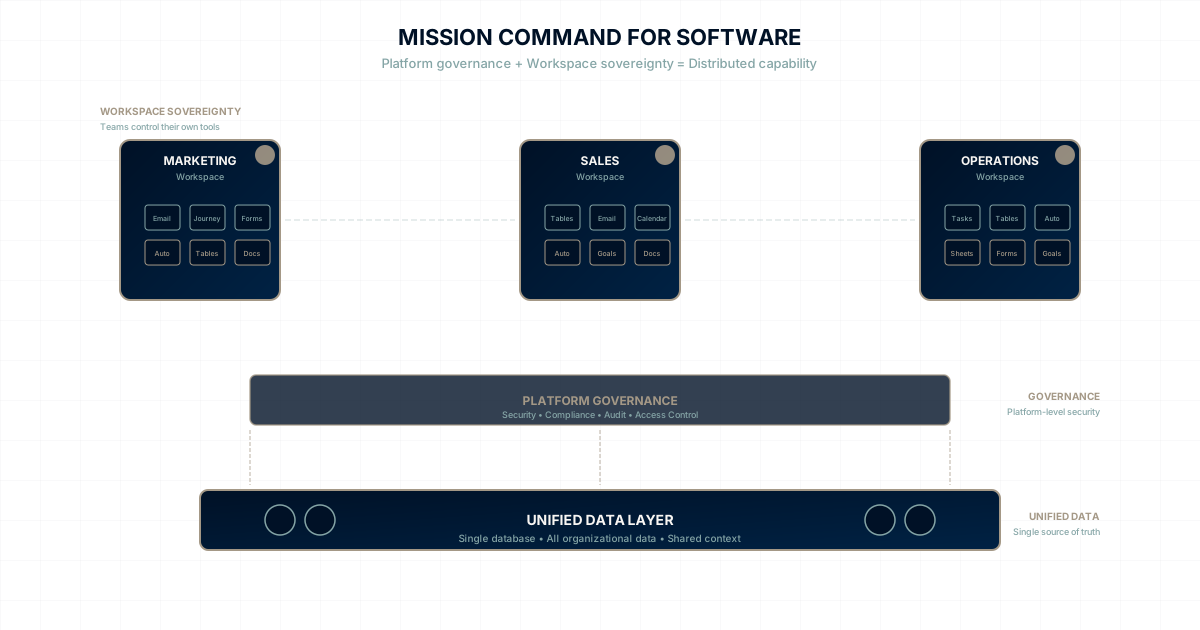
In WaymakerOS, every workspace draws from the same organizational database. Goals, contacts, projects, tasks—all unified. When marketing sees a customer, sales sees the same customer. When operations updates a project, leadership dashboards reflect it.
This isn't integration. It's architectural unity.
How it manifests:
- Single database for all organizational data
- No product boundaries fragmenting information
- Every tool shares the same context
- Cross-workspace visibility is native, not bolted on
Comparison to central control: Microsoft 365 has Exchange data, SharePoint data, Dynamics data, Teams data—each requiring integration. Google has Gmail data, Drive data, Sheets data—each siloed.
WaymakerOS has organizational data. Period.
2. Purpose and Direction Clarify
Military Insight: When everyone asks the same strategic questions, alignment happens naturally. The 7 Questions ensured commanders at every level understood the mission, the constraints, and the commander's intent.
Software Principle: Organizational context available everywhere.
In WaymakerOS, organizational goals, OKRs, and strategic priorities aren't hidden in a separate system. They're woven into the fabric of daily work.
How it manifests:
- Goals and OKRs visible across workspaces
- Tasks link to strategic objectives
- Dashboards show progress against organizational priorities
- AI (Waymaker One) understands organizational context
Comparison to central control: Most organizations have goals in one system, tasks in another, and a manual process to connect them. WaymakerOS connects them structurally.
When a team member opens their workspace, they don't just see tasks—they see how those tasks connect to team goals, which connect to organizational objectives. Purpose clarifies through structure, not through meetings.
3. Trust and Authenticity Increase
Military Insight: By explicitly trusting commanders to make decisions, Mission Command created genuine accountability. People trusted with authority take ownership.
Software Principle: Workspace sovereignty over tools and capabilities.
The most radical architecture decision in WaymakerOS: workspaces control their own tools.
Marketing doesn't request email automation capability from IT—marketing deploys Journeys in their workspace. Sales doesn't wait for CRM modifications—sales builds Tables views with the fields they need. Operations doesn't submit automation tickets—operations creates Automations directly.
How it manifests:
- Tools available to all workspaces by default
- Workspace-level configuration without admin approval
- Automations, custom fields, workflows—all team-controlled
- No capability gatekeeping
Comparison to central control: In Microsoft/Google architecture, global admins control what features are available. Want a new field? Admin approval. New automation? Admin approval. Different workflow? Admin approval.
WaymakerOS trusts workspaces. That trust creates ownership.
4. Speed and Volume of Collaboration Accelerate
Military Insight: Without centralized bottlenecks, decisions happen faster. The OODA loop (Observe, Orient, Decide, Act) tightens dramatically when you remove layers of approval.
Software Principle: No provisioning bottlenecks between need and capability.
The architecture that enables speed is simple: eliminate the queue.
When a marketing team needs a new email journey, they don't enter an IT queue. They build it. When sales needs a custom report, they don't wait for BI development. They create it. When operations needs to track a new metric, they don't submit a ticket. They add it.
How it manifests:
- Zero-step provisioning for workspace capabilities
- Real-time deployment of automations and workflows
- Instant access to all platform tools
- No approval workflows for operational changes
Comparison to central control: Central control architecture creates structural latency. Request → Approval → Queue → Assignment → Development → Testing → Deployment. Each step adds days or weeks.
WaymakerOS architecture eliminates the steps: Need → Build → Deploy. Hours, not weeks.
5. Decision-Making Decentralizes
Military Insight: The right decisions happen at the right level. Strategic decisions stay with senior commanders. Tactical decisions move to the edge where information is freshest.
Software Principle: Platform governance plus workspace autonomy.
This principle resolves the apparent tension between autonomy and control. Both can exist—they just operate at different levels.
Platform-level governance:
- Security policies
- Compliance requirements
- Audit trails
- Data governance
- Organization-wide access controls
Workspace-level autonomy:
- Tool configuration
- Workflow design
- Automation rules
- Custom fields and views
- Team-specific processes
How it manifests:
- Security policies enforced at the platform level
- Compliance happens structurally, not through feature gatekeeping
- Workspaces have full autonomy within governance boundaries
- IT shifts from gatekeeper to platform enabler
Comparison to central control: Central control conflates governance and gatekeeping. Want security? Control access. Want compliance? Require approval. Want oversight? Review every change.
WaymakerOS separates them. Governance at the platform level. Autonomy at the workspace level. Both, simultaneously.
The Technical Implementation
These principles required specific technical decisions:
Single Unified Database
Not "integrated databases." Not "synced databases." One database.
Every contact, every task, every project, every goal, every document—all in the same place. When you query the database, you're not asking "which product has this data?" You're asking "what do I need to know?"
Technical implications:
- No sync delays between products
- No reconciliation jobs
- No duplicate data across systems
- No integration maintenance
Workspace-Scoped Configuration
Each workspace maintains its own configuration without affecting others.
Marketing's Tables schema doesn't impact sales' schema. Operations' Automations don't conflict with service's workflows. Custom fields, views, automations—all workspace-scoped.
Technical implications:
- No global admin bottleneck
- No cross-workspace conflicts
- No "wait for the next release" for configuration changes
- Teams iterate at their own pace
Context-Aware APIs
WaymakerOS APIs don't just return data—they return context.
When you build a custom app on Waymaker Host, it automatically knows:
- Which workspace it's running in
- What the organizational goals are
- Who the user is and their permissions
- What data they can access
Technical implications:
- Custom apps inherit organizational context
- No manual context-passing
- Apps understand the business automatically
- 20 lines of code instead of 200
Platform-Level Security
Security isn't per-tool—it's per-platform.
Authentication, authorization, audit logging, compliance controls—all handled at the platform level. Individual tools inherit security; they don't implement it separately.
Technical implications:
- Consistent security across all features
- Single audit trail for everything
- Compliance checked once, not per-tool
- Security updates propagate automatically
Why Every Feature Reflects the Philosophy
Look at any WaymakerOS feature and you'll see Mission Command principles embedded:
Tables
- Workspace sovereignty: Each workspace creates its own schemas
- Unified data: Tables data joins seamlessly with all other organizational data
- No provisioning: Create tables instantly, no database team required
Journeys
- Workspace sovereignty: Marketing deploys campaigns without IT approval
- Context-aware: Journeys access full customer history automatically
- Speed: From idea to live campaign in hours
Automations
- Workspace sovereignty: Teams create business logic without developers
- Unified data: Automations trigger across any organizational data
- Trust: Workspaces control their own automation rules
Host
- Workspace sovereignty: Deploy apps without procurement or IT involvement
- Context-aware: Apps inherit organizational data and authentication
- Trust: Teams deploy what they need, without asking for a budget line per app
Waymaker One (AI)
- Unified data: AI understands full organizational context
- Purpose clarity: AI knows goals, projects, and priorities
- Aligned outcomes: AI recommendations connect to strategic objectives
The Alternative Was Impossible
Early in development, we considered a more traditional approach: build excellent individual tools, then integrate them.
The math killed it.
If you build 20 tools as separate products, you need 190 integrations for full interconnection (n × (n-1) / 2). Each integration requires ongoing maintenance, creates sync delays, and introduces potential failure points.
Worse, you've recreated the central control problem. Someone has to manage the integrations. Someone has to maintain the connections. Bottlenecks reform.
The only way to achieve operations at the edge was to build for it from the foundation. One database. One platform. Twenty views into unified organizational data.
You can't integrate your way to workspace sovereignty. You have to architect it.
The Resulting System
What emerges from these principles is a system that feels fundamentally different:
For Teams:
- Everything you need to do your job
- No waiting for IT provisioning
- Changes at the speed of thought
- Ownership over your operational environment
For Leaders:
- Visibility across all operations
- Strategic context connected to daily work
- Governance without gatekeeping
- Teams that move faster than competitors
For IT:
- Platform enablement instead of request processing
- Security at the architecture level
- Compliance built in, not bolted on
- Strategic technology decisions instead of ticket queues
For the Organization:
- Unified data from day one
- AI that actually works (because it has context)
- Custom capabilities without enterprise contracts
- Scaling without adding complexity
The Invitation
Mission Command transformed military operations by trusting commanders at the edge. The 7 Questions of Leadership transforms organizational alignment by pushing strategic clarity to every level.
WaymakerOS transforms business software by pushing operations to the edge.
Every architecture decision, every feature choice, every technical tradeoff flows from this philosophy. The result is software that trusts the people using it—and is more powerful because of that trust.
The people doing the work have the tools to do the work.
That's not a tagline. It's an architecture.
Continue the Journey
- Operations at the Edge: Why WaymakerOS Exists: The full philosophy
- The Falklands Lesson for Business Software: The origin story
- Workspace Sovereignty: What autonomous workspaces look like
- Central Control vs. Operations at the Edge: Direct architectural comparison
WaymakerOS. The way to make your business OS. Make the way.
Mission Command for software.
Experience the architecture with Commander.
About the Author

Stuart Leo
Stuart Leo founded Waymaker to solve a problem he kept seeing: businesses losing critical knowledge as they grow. He wrote Resolute to help leaders navigate change, lead with purpose, and build indestructible organizations. When he's not building software, he's enjoying the sand, surf, and open spaces of Australia.