The two most important words in enterprise software in 2026 are not "AI" and "automation." They are "record" and "intelligence."
For twenty years, the company that owned your data owned your business. Salesforce built $200 billion in market capitalisation on that principle. Your customer records, deal history, and contact database created a switching cost so high that you would pay almost any price to avoid rebuilding it elsewhere.
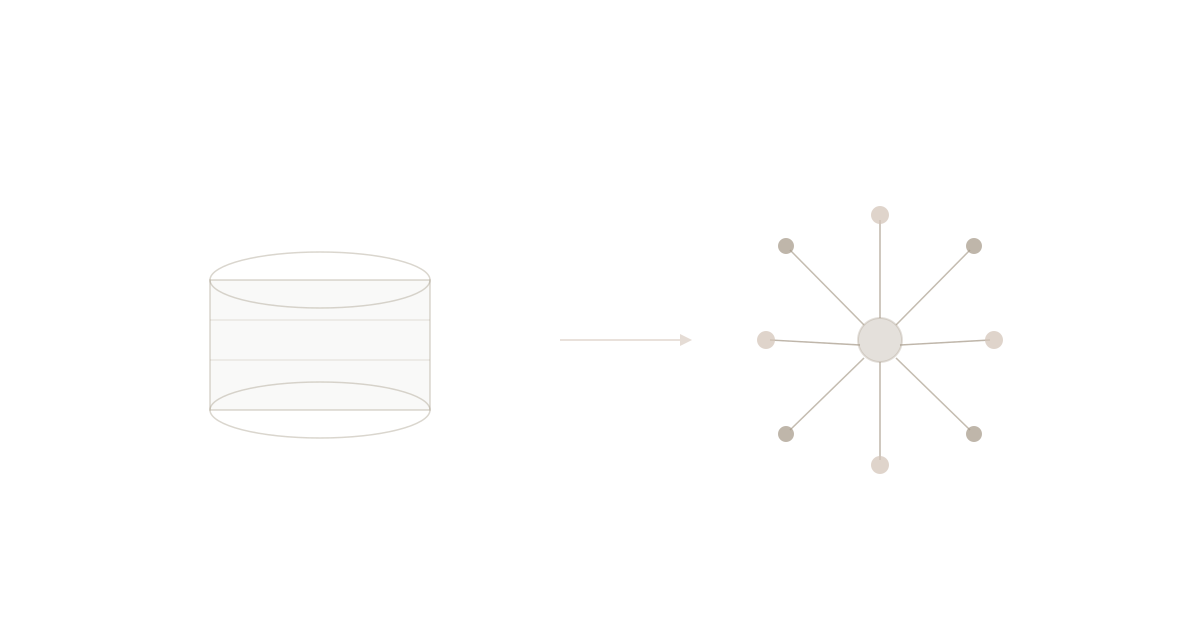
a16z published a landmark analysis in early 2026 naming the shift that is now rewriting that logic. The database layer — the system of record — is becoming infrastructure. The reasoning layer — the system of intelligence — is becoming the product. Understanding the difference between these two architectures is now a strategic requirement, not an academic exercise.
What a System of Record Is (And Why It Dominated)
A system of record is exactly what it sounds like: a centralised database that holds the canonical version of your operational reality. Your CRM is the system of record for customer relationships. Your project management platform is the system of record for work status. Your accounting software is the system of record for financial transactions.
The genius of the system-of-record model was that it solved a real problem — the fragmentation and chaos of data scattered across people, spreadsheets, and email threads. Before Salesforce, sales managers kept customer context in notebooks, email, and memory. The CRM pulled it into one place, making it searchable, transferable, and auditable.
The CRM Model That Captured a Generation
The switching cost of a system of record is the accumulated data itself. This is why Salesforce still generates $35 billion in annual revenue despite costing $50,000+ per year for a team-sized implementation. Your five years of deal history, contact notes, and customer relationships are in there. Leaving means rebuilding them elsewhere.
For most of the last two decades, this was enough. The company with the most complete record of its operations had a meaningful advantage. Better data meant better decisions. Better decisions meant better outcomes.
But that equation depended on one assumption that is now being dismantled: that humans are the ones reading and reasoning across the data.
What a System of Intelligence Does Instead
A system of intelligence is an orchestration and reasoning layer that sits above the record layer. Where a system of record asks "where is the data?" a system of intelligence asks "what does the data mean, and what should we do about it?"
Anthropic's work on AI at scale makes the distinction concrete: individual AI tools make people faster at tasks. A system of intelligence makes the organisation smarter about decisions. The difference is not the quality of the AI model — it is the architecture that connects it to organisational context.
The signals a system of intelligence synthesises go far beyond what any single record system captures:
- Task and goal data — what the team is working on and whether it aligns with strategy
- Document and decision history — what was decided, by whom, and why
- Communication patterns — what is being escalated, delayed, or avoided
- Financial and operational data — how work maps to outcomes
- External signals — market changes, customer behaviour, competitive moves
A CRM can store all of your customer records. It cannot synthesise those records against your current goals, your team's capacity, your recent wins and losses, and the external context your sales team is navigating. That synthesis is what a system of intelligence does.
The Facebook Analogy That Changes the Frame
a16z uses the Facebook analogy to explain the shift, and it is worth dwelling on because it reframes the competitive landscape entirely.
Facebook's friend graph was the system of record. It held the canonical data — who your friends are, what your profile contains, your social connections. This was immensely valuable. It was also a moat: no competitor could replicate it without convincing hundreds of millions of people to re-enter their social graphs.
Then Facebook built the News Feed. OpenAI's research on algorithmic systems shows the same pattern: the algorithm that selects what you see, in what order, based on what the platform has learned about you — that became the product. The friend graph became infrastructure consumed at the API layer. Nobody visits their social graph directly. They experience the feed.
The same transition is happening in business software. The CRM becomes infrastructure. The intelligence layer that reasons across the CRM, plus calendar, plus email, plus task data, plus goal progress — that becomes the product.
The system of record does not disappear — it becomes one input among many, consumed programmatically by the reasoning layer above it.
The New Switching Cost: Logic, Not Data
Here is the strategic implication that most businesses have not fully grasped yet: when the intelligence layer becomes the product, the switching cost changes fundamentally.
Old switching cost: Your data is here. Migrating it is painful and lossy. You stay because starting over means rebuilding years of records.
New switching cost: Your logic is here. Your workflows, your institutional memory, your domain-specific intelligence are encoded in the platform. You stay because the platform knows how your business thinks — and that knowledge is not exportable.
This matters for how you evaluate platforms today. A system of record with better storage is a marginal improvement. A system of intelligence that accumulates your domain logic is a compounding advantage.
McKinsey's research on AI-driven organisations found that the companies extracting the most value from AI are not the ones with the most data — they are the ones with the most domain logic encoded in their systems. Every workflow automated, every decision pattern captured, every process built is a deposit in the intelligence layer that earns compound returns.
Where the Shift Is Happening First
a16z's analysis focuses on GTM software — Salesforce, HubSpot, and the tools that sales and marketing teams use. That makes sense: GTM has the clearest measurement of intelligence-layer outcomes (pipeline, conversion rate, revenue) and the richest signal sets (CRM + email + calendar + call recordings + product usage).
But the shift is not limited to GTM. It is happening across every operational domain:
Operations: The system of record is the project management tool. The system of intelligence synthesises task progress, team capacity, goal alignment, and external dependencies to surface decisions before they become crises.
Finance: The system of record is the accounting software. The system of intelligence synthesises transactions, goals, forecasts, and operational data to surface insight that drives better financial decisions — not just reports of what already happened.
People: The system of record is the HR system. The system of intelligence synthesises performance data, goal progress, skill profiles, and organisational context to surface who needs support, recognition, or development before issues escalate.
For SMBs, this shift creates an unusual opportunity. Enterprise vendors are retrofitting intelligence onto record systems built in the 2000s. A business starting fresh with a properly architected platform can build the intelligence layer from day one, without the legacy debt.
The 2026 Evaluation Framework
When evaluating business platforms in 2026, the question is no longer "where does my data live?" It is "where does my reasoning live?"
Apply this framework to every platform decision:
1. Does it synthesise across multiple signal sources? A system of intelligence cannot be built on a single data type. Platforms that silo tasks from goals from documents from email are record systems with intelligence-layer aspirations. True intelligence requires the full signal set.
2. Does it encode domain logic or just execute it? A workflow automation that runs a process is executing logic. A platform that learns from the process, surfaces exceptions, and improves over time is encoding intelligence. The difference is whether the platform gets smarter as you use it.
3. Does the switching cost grow over time? In a system of record, the switching cost is the data (static, exportable). In a system of intelligence, the switching cost is the encoded logic and institutional memory (dynamic, non-exportable). If the switching cost is not growing, you are building on a record layer.
Building Both Layers With WaymakerOS
WaymakerOS is architected for the post-record era. Commander is the system of record — 20 connected tools that build a rich, multi-signal operational record. Run an entire business from one platform and eliminate the data fragmentation that prevents intelligence-layer reasoning.
Host is the build layer — the platform where domain logic lives. Every custom app, every Ambassador function, every automation encodes a piece of how your specific business operates. That logic compounds.
One is the intelligence layer — the synthesis engine that connects Commander's record to Host's logic and surfaces the decisions, summaries, and intelligence your team needs.
The architecture a16z identified as defining the next decade of business software is available at SMB scale, from $19 per seat per month. The businesses that start building toward it now will have a compounding advantage over those that wait.
The system-of-record era rewarded those who centralised data. The system-of-intelligence era rewards those who centralise reasoning. Read more about what a system of intelligence is and explore why your current CRM may be holding you back.
About the Author

Stuart Leo
Stuart Leo founded Waymaker to solve a problem he kept seeing: businesses losing critical knowledge as they grow. He wrote Resolute to help leaders navigate change, lead with purpose, and build indestructible organizations. When he's not building software, he's enjoying the sand, surf, and open spaces of Australia.