For the last twenty years, competitive advantage in business software came from one thing: who owned your data. Salesforce built a $200 billion company on that single insight. Your customer records, your deal history, your contact database — the switching cost was the data itself.
That logic is breaking down.
In 2026, a16z identified a structural shift in how business software creates value. The layer that matters is no longer the one that stores the data. It is the one that reasons across it. They named it the system of intelligence — and it changes what every business, at every size, should be building toward.
This article explains what that means, why it matters for SMBs specifically, and what the architecture looks like in practice.
The Layer That Creates Value Has Shifted
To understand why this shift matters, you need to understand why systems of record became dominant in the first place.
A system of record is a centralised database that holds the canonical version of your operational context. Your CRM is the system of record for customer relationships. Your project management tool is the system of record for work status. Your accounting software is the system of record for financial transactions.
The power of a system of record comes from centralisation. If your customer data is in one place, you avoid the fragmentation problem that costs businesses thousands of hours annually. If your team's work status lives in one tool, you avoid duplicate entries and conflicting versions. The record layer solves the chaos of scattered information.
From Data Gravity to Intelligence Gravity
But here is the thing about data gravity: it assumes humans are the ones reading and reasoning across the data. When a sales manager checks the CRM before a meeting, they need one place to look. When a project lead reviews status, one dashboard beats twelve.
AI changes this assumption fundamentally. An AI agent does not need a single UI. It pulls from a dozen data sources simultaneously via API. It does not care whether your customer history is in Salesforce or in a table you built yourself. What it needs is not centralised data — it needs centralised reasoning.
That is the system of intelligence. Not a place to store data, but a layer that synthesises signals from multiple sources and delivers actionable intelligence. The gravity has shifted from the data layer to the reasoning layer.
Anthropic's research on AI systems shows that the value of AI at the organisational level is not in individual task performance — it is in connecting context across roles, decisions, and time. The system of intelligence is what makes that connection possible.
What a System of Intelligence Actually Is
A system of intelligence is an orchestration and reasoning layer that sits above your systems of record. It synthesises signals from multiple sources — tasks, goals, documents, email, financial data, team structure — and produces decisions, summaries, alerts, and actions.
The analogy that lands cleanly: Facebook's friend graph was the system of record. The News Feed algorithm was the system of intelligence. The friend graph didn't disappear — it became infrastructure consumed via API. The algorithm became the product. OpenAI's approach to system-level AI follows the same pattern: the value is not in storing context, it is in reasoning across it.
For a 20-person business, a system of intelligence looks like this:
- Your CEO asks for a board report. Instead of assembling data from six tools, the intelligence layer synthesises goals progress, task completion, financial data, and recent decisions into a structured report automatically.
- A new sales hire joins. Instead of spending a month learning context that lived in the previous rep's head, the intelligence layer surfaces relevant deal history, customer preferences, and decision patterns from the record layer below it.
- A process bottleneck appears. The intelligence layer detects the pattern across task data, email threads, and goal tracking — and surfaces it before it becomes a crisis.
This is not science fiction. It is the architecture that well-funded enterprises are building for $50K+ per year. The shift happening now is that this architecture is becoming accessible to businesses with 10, 20, or 50 people.
The Three-Layer Architecture
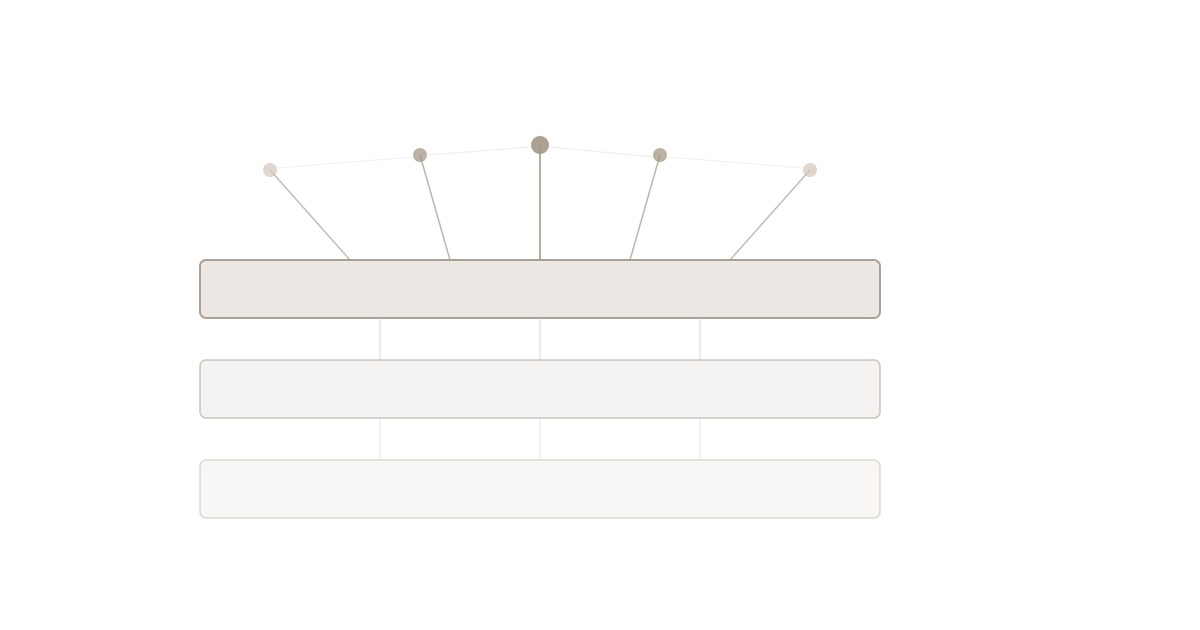
The full architecture has three layers, and all three matter:
Layer 1 — System of Record. This is where operational data lives. Tasks, goals, documents, emails, financial records, org structure. The record layer captures what happened, who decided what, and what the current state of the business is. Without a rich record layer, the intelligence layer has nothing to reason across.
Layer 2 — Build Layer. This is where domain logic lives. The custom apps, automations, and AI agents that encode how your specific business operates. Every Ambassador function deployed, every workflow automated, every integration built adds to the build layer. This is what makes a platform different from a tool — a platform has a build layer.
Layer 3 — System of Intelligence. This is where reasoning lives. The intelligence layer synthesises signals from the record layer, executes logic from the build layer, and surfaces decisions, summaries, alerts, and actions. The more data and domain logic below it, the smarter it becomes.
Why the Record Layer Alone Is No Longer Enough
The businesses that recognise this shift earliest will have an advantage that compounds. Here is why the record layer alone is increasingly insufficient.
First, AI makes multi-source reasoning trivially easy. Your team used to need a single system of record because humans can only look in one place at a time. AI agents can synthesise five data sources simultaneously. The constraint that made centralised records essential is disappearing.
Second, the value has always been in the synthesis, not the storage. McKinsey's research on data-driven organisations consistently shows that the companies that extract the most value from data are not the ones with the most data — they are the ones with the best reasoning capabilities applied to that data. A system of intelligence is the architectural expression of that capability.
Third, the switching cost is now logic, not data. In the system-of-record era, you stayed with Salesforce because your data was there. In the system-of-intelligence era, you stay because your domain logic is encoded there. The workflows, the institutional memory, the decision patterns — these compound over time and become genuinely difficult to replicate elsewhere.
Learn more about how institutional knowledge loss compounds over time and why encoding it in an intelligence layer changes the dynamic.
The Compound Effect: Why This Architecture Gets Stronger Over Time
The system-of-record architecture has a ceiling. You can only get so much value from better stored data. The system of intelligence architecture has no ceiling. Every task completed adds to the record layer. Every workflow built adds to the logic layer. Every decision recorded makes the intelligence layer more capable.
This is the flywheel that matters for SMBs. Start with Commander — 20 connected tools that build a rich system of record. Add custom apps and automations via Host — build the software your specific business needs without a developer. Layer One on top — the intelligence layer that synthesises everything and surfaces insight.
After six months on this architecture, your board reports write themselves. After a year, new hires inherit the institutional memory of the people who came before them. After two years, the intelligence layer knows how your business thinks — and that knowledge is impossible to replicate by switching to a different platform.
McKinsey found that AI-enabled organisations outperform peers by 15-20% on key metrics within 18 months. The differentiator is not the AI model — it is the architecture that connects AI to organisational context.
How to Evaluate Your Current Architecture
Three questions to assess where your business stands:
1. Where does your intelligence live? If the answer is "in my head" or "in Sarah's head" or "in spreadsheets that only Marcus understands" — you have a record-layer problem that is preventing you from building an intelligence layer. Start by consolidating into a proper system of record before adding intelligence capabilities.
2. What happens when someone senior leaves? If your organisation loses significant capability when a key person departs, your intelligence is locked in people rather than encoded in a system. A proper intelligence layer captures decision patterns and institutional knowledge so it transfers, not walks out the door. This is one of the most expensive problems growing businesses face.
3. Can your AI see the whole business? If you are using Claude or ChatGPT for isolated tasks but cannot get a cross-business synthesis, you do not have an intelligence layer — you have individual AI tools. The system of intelligence is the layer that connects them.
Building the Intelligence Layer With WaymakerOS
WaymakerOS is designed explicitly for this three-layer architecture.
Commander is the system of record — 20 connected tools that capture tasks, goals, documents, sheets, email, contacts, and financial data in one place. The record layer is rich from day one.
Host is the build layer — deploy custom apps and AI agents that encode your domain logic. Every Ambassador function you deploy is organisational intelligence that cannot be replicated by a competitor using the same tools. Build directly from your IDE and deploy to a platform that knows your business context.
One is the intelligence layer — the synthesis engine that connects Commander's data to Host's logic and surfaces the intelligence your team needs to make better decisions faster.
The architecture a16z says will define the next decade of business software is already available for SMBs at $19 per seat per month. The businesses that start building toward it now will compound that advantage for years.
The system of intelligence is not a product you buy — it is an architecture you build. Start with the record layer, encode your domain logic in the build layer, and let the intelligence layer compound on top. Read more about what makes a platform different from a deployment tool and explore how to build software without a developer.
About the Author

Stuart Leo
Stuart Leo founded Waymaker to solve a problem he kept seeing: businesses losing critical knowledge as they grow. He wrote Resolute to help leaders navigate change, lead with purpose, and build indestructible organizations. When he's not building software, he's enjoying the sand, surf, and open spaces of Australia.