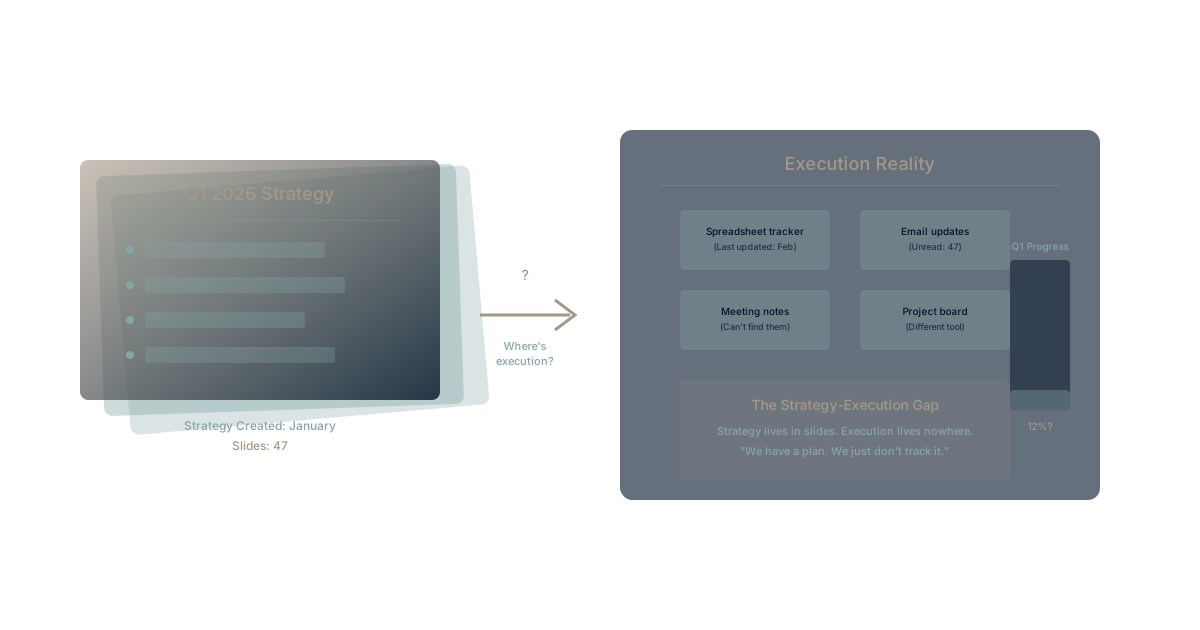
January. The leadership team gathers for strategic planning. Three days of intense discussion. Forty-seven PowerPoint slides. A beautiful deck summarizing the year's strategy.
December. That deck sits unchanged in a shared folder. Progress? Unknown. Alignment? Questionable. Connection between strategy and daily work? Nonexistent.
This is the strategy-execution gap—and it's not an execution problem. It's a systems problem.
The PowerPoint Strategy Pattern
How Strategic Planning Actually Works
The typical strategic planning process:
- Planning retreat: Leadership discusses direction, makes decisions
- Deck creation: Strategy summarized in presentation format
- Communication: Deck presented to broader organization
- Distribution: File shared via email or document system
- Execution: Teams go back to their tools and work
- Review: Quarterly check-ins with... that same deck?
The strategy exists as a static artifact. Execution happens in completely different systems. The connection between them is human memory and manual updates.
Why PowerPoint Became the Default
PowerPoint won strategy communication for understandable reasons:
Visual appeal: Strategy benefits from visual presentation Flexibility: Slides accommodate any type of content Familiarity: Everyone knows how to use it Shareability: Easy to distribute and present
But PowerPoint optimizes for communication, not connection. A strategy deck is a snapshot—it has no relationship to the ongoing work it's supposed to guide.
The Fundamental Disconnect
Strategy in slides. Work in project tools. Goals in spreadsheets. Progress in stand-ups.
Between these systems: nothing but human effort.
Someone must manually:
- Translate strategy into projects
- Track project progress against strategy
- Update leadership on alignment
- Reconcile different systems' views
This manual bridging consumes enormous effort and fails constantly. The integration tax applied to your most important decisions.
The Costs of Disconnected Strategy
Strategy Drift
Without live connection, strategy and execution drift apart:
Month 1: Strategy understood, execution aligned Month 3: Some interpretations diverge, priorities shift Month 6: Daily work loosely related to original strategy Month 9: Teams optimize locally, losing strategic coherence Month 12: Next year's planning starts from unclear baseline
This drift isn't caused by bad actors. It's structural—the natural result of disconnected systems.
Invisible Progress
Leadership asks: "How are we doing against the strategic plan?"
Answering requires:
- Review the strategy deck (what did we commit to?)
- Query multiple project systems (what have teams done?)
- Manually map execution to strategy (does work relate to goals?)
- Synthesize into update format (how to communicate status?)
This process takes days, produces stale data, and happens infrequently. By the time you know you're off track, months have passed.
Cascading Confusion
Each level of the organization translates strategy differently:
- Executive slide: "Expand into enterprise market"
- VP interpretation: "Need 10 enterprise deals"
- Director action: "Build enterprise features"
- Team execution: "Work on features that seem enterprise-relevant"
Without connected systems, these translations diverge. Everyone thinks they're executing strategy. Nobody has visibility into whether the pieces add up.
Strategic Amnesia
Come December, what happened to the strategy?
- Which initiatives succeeded?
- Which were abandoned? Why?
- What market conditions changed?
- What did we learn?
This information lives in people's memories, scattered documents, and meeting notes nobody can find. Next year's planning starts with institutional business amnesia about what actually happened.
The Strategy Execution Architecture Problem
What Strategy Execution Requires
Effective strategy execution needs:
Connection: Strategy linked to projects linked to tasks Visibility: Progress visible at every level Alignment: Work traceable to strategic objectives Adaptation: Ability to adjust as conditions change Memory: Learning captured for future planning
PowerPoint provides none of these. It was never designed to.
The Tool Gap
Organizations try to bridge with additional tools:
OKR software: Tracks goals but disconnected from project work Project management: Tracks tasks but disconnected from strategy Strategy tools: Create strategic plans but disconnected from execution BI dashboards: Show metrics but disconnected from context
Each tool solves a piece. None connects the whole. You end up with a tool sprawl problem specific to strategy.
The Human Bridging Burden
Without connected systems, humans become the integration layer:
- Chiefs of staff: Translate strategy to teams
- Program managers: Track cross-functional execution
- Analysts: Build manual reports connecting systems
- Leaders: Hold context in their heads
This is expensive, fragile, and doesn't scale. When key people leave, strategic continuity leaves with them.
Building Connected Strategy Execution
Strategy as Living System
Instead of static documents, strategy should be:
Linked: Goals connected to projects connected to tasks Updated: Progress flows automatically from execution Visible: Status available to those who need it Adaptive: Changes cascade through the system
This requires platforms designed for connection, not slides designed for presentation.
The Execution Architecture
Connected strategy execution needs:
- Strategic layer: Vision, mission, annual objectives
- Planning layer: Initiatives, OKRs, key results
- Execution layer: Projects, tasks, deliverables
- Measurement layer: Metrics, outcomes, learning
These layers must live in the same system or truly integrate. Manual bridging fails.
Decision Documentation
Strategy evolves through decisions. Those decisions need capture:
- Why did we pivot from Plan A to Plan B?
- What triggered the change in priorities?
- Who decided and based on what?
See decision documentation for why this matters and how to do it.
Continuous Alignment
Strategy alignment shouldn't wait for quarterly reviews:
Weekly: Team work aligned to projects (automatic) Monthly: Projects aligned to objectives (visible) Quarterly: Objectives assessed against strategy (connected) Annually: Strategy refreshed with full learning (remembered)
When connection is structural, alignment becomes continuous.
From Slides to Systems
Assess Your Current State
Before changing tools, understand your gap:
- How long does it take to assess strategy progress?
- How many systems must be queried?
- How many people must translate between strategy and execution?
- What's lost between planning and review?
The answers reveal whether you have a system problem or just a process problem.
Define Connection Requirements
What would connected strategy look like for you?
- Which strategic objectives need tracking?
- What execution systems contain relevant progress?
- Who needs visibility at what level?
- How frequently must alignment be assessed?
These requirements guide platform selection.
Implement Incrementally
Full transformation is risky. Start with:
- Key objectives: Connect your most important strategic goals
- Flagship projects: Link highest-visibility initiatives
- Leadership visibility: Ensure executives see connected view
- Prove the model: Demonstrate value before expanding
Once connection proves valuable, expand systematically.
Experience Connected Strategy with Waymaker
Want to see what connected strategy execution looks like? Waymaker Commander connects strategy to execution in one workspace—goals to projects to tasks, with visibility at every level.
No more strategy decks disconnected from work. No more manual progress tracking. Just strategy and execution, connected by design.
Register for the beta and experience strategy that stays connected to reality.
Strategy in slides stays in slides. Strategy in connected systems drives connected execution. The gap between planning and results isn't an execution problem—it's an architecture problem. Organizations that close this gap don't just plan better; they execute what they plan. Learn more about spreadsheet strategy traps and explore what matters in OKR software.
Stuart Leo has facilitated 300+ strategic planning sessions. This analysis reflects the consistent pattern: great strategy fails not in conception but in connection to execution.
About the Author

Stuart Leo
Stuart Leo founded Waymaker to solve a problem he kept seeing: businesses losing critical knowledge as they grow. He wrote Resolute to help leaders navigate change, lead with purpose, and build indestructible organizations. When he's not building software, he's enjoying the sand, surf, and open spaces of Australia.