Every custom app starts with a blank database. That sentence should trouble you more than it does.
You build a client portal. It needs to know which team member owns the account. So you create a users table, import names, set up roles, and wire up assignments. You build a reporting dashboard. It needs to know which goals the metrics connect to. So you create a goals table, manually define objectives, and map KPIs to targets. You build an internal workflow tool. It needs to know who to notify when something changes. So you create a roles table, define a permissions model, and configure notification routing.
Every single custom app you build starts from zero. Even when your organisation already has all of this information — goals, teams, roles, documents, data — living in other systems.
This is the fundamental waste in custom software today. Not the code. The context.
The Blank Slate Problem
Consider what happens when a development team — or a business user with AI coding tools — sets out to build a custom application.
They open their IDE. They create a new project. They stare at an empty database schema.
Then the questions begin:
- Where do we store user information?
- How do we model team structures?
- What's our permissions model?
- How do we connect this to our goals?
- Where does organisational context come from?
These questions have already been answered somewhere in the organisation. The team structure exists in your HR system. The goals exist in your OKR tool. The roles exist in your identity provider. The documents exist in your knowledge base.
But none of that context is accessible to the new application. So the team rebuilds it from scratch — a pale imitation of the real organisational structure, frozen in time the moment someone copies it over, drifting further from reality with every passing week.
Research from Gartner consistently shows that the majority of custom app development effort goes not into unique business logic but into rebuilding foundational data models that already exist elsewhere. It is infrastructure work disguised as product work.
Why Every Platform Falls Short
The blank slate problem is not new. Platforms have been trying to solve it for years. Here is where they stand today.
Building on Vercel, Netlify, or Cloudflare
These are exceptional hosting platforms. You deploy frontend applications, serverless functions, and static sites with speed and reliability.
But they give you infrastructure, not context. Your app gets a URL, a build pipeline, and a CDN. It does not get your team structure. It does not get your goals. It does not know who reports to whom or which projects matter this quarter.
Every app you deploy starts with a blank slate. You bring whatever context you need by building integrations — to your CRM, your project management tool, your identity provider, your goals platform. Each integration is custom. Each integration is fragile. Each integration is another surface area to maintain. This is the app sprawl problem applied to custom development — every new app multiplies the integration burden.
Building on Retool or Appsmith
Internal tool builders solve part of the problem. They connect to databases and APIs, giving your app access to raw data. You can build dashboards, admin panels, and internal workflows without writing much code.
But there is a crucial distinction between data connection and business context. Retool connects to your PostgreSQL database. It can read rows from a table. That is data access.
What it cannot do is understand that a row in your customers table is assigned to a team member who is part of a sales team working toward a Q2 revenue goal with three key results, and that the customer's onboarding status affects a metric that rolls up to an organisational objective reviewed by leadership every Monday.
That is business context. And it does not exist in any single database table. It exists in the relationships between goals, teams, roles, tasks, documents, and data — relationships that only a unified productivity platform can maintain.
Building on WaymakerOS
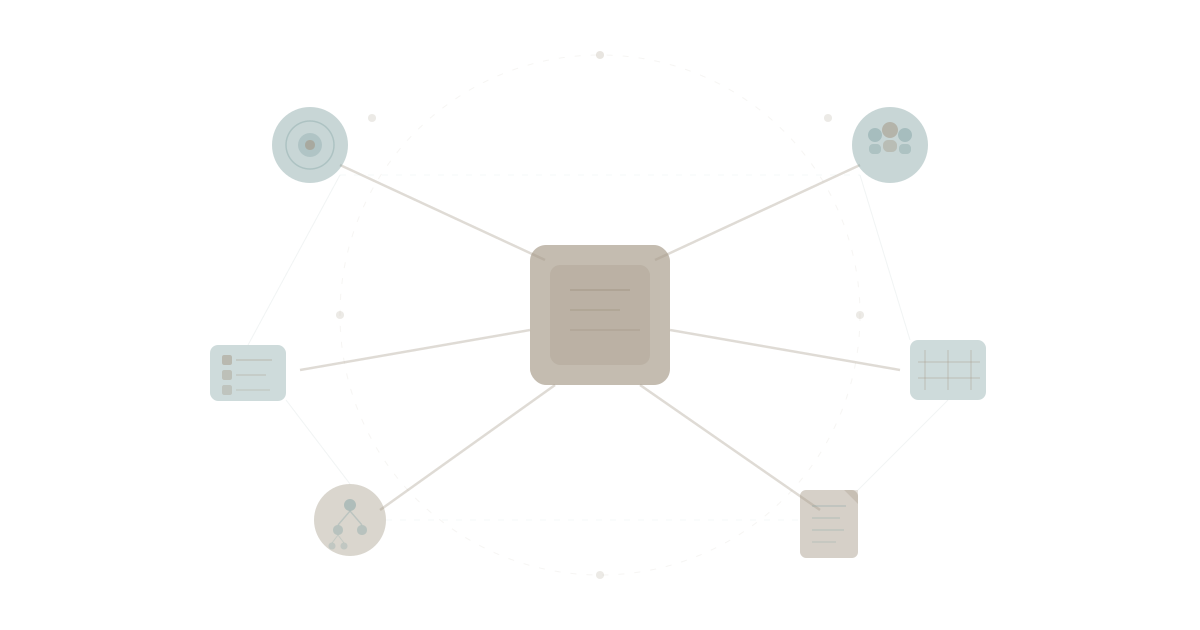
Here is the difference. When you build a custom app on WaymakerOS Host, your application inherits the entire Commander data model from day one.
Your app does not start with a blank database. It starts with:
- Goals and key results — every OKR and objective your organisation has defined, with measurable targets and progress tracking
- Team structure — who works in which team, who reports to whom, what capacity exists
- Roles and permissions — who is accountable for what, with organisation-scoped security policies
- Tasks and projects — the active work, with status, assignments, priorities, and kanban boards
- Documents and knowledge — strategy documents, meeting notes, procedures, saved in context
- Sheets and data models — structured data with typed columns, filters, and relationships
Your client portal does not need a users table. It queries the existing team and role data. Your reporting dashboard does not need a goals table. It reads the live OKRs. Your workflow automation does not need a notification routing system. It uses the existing role assignments to determine who should be notified.
This is what context-aware custom apps look like. Applications that understand the business they serve because they are built on the same platform that runs the business.
Context Inheritance in Practice
The concept becomes concrete when you see it applied to real scenarios.
Scenario: Client Delivery Portal
A professional services firm needs a portal where clients can track project status, view deliverables, and communicate with their team.
Without context inheritance (building on a blank slate):
- Create a clients table and import client data
- Create a team members table and map people to clients
- Create a projects table and define status workflows
- Build a permissions model so clients only see their own data
- Create an assignments system linking team members to projects
- Build a notification system for status changes
- Hope the data stays in sync with reality
With context inheritance (building on WaymakerOS):
- Query Commander workspaces for client projects — they already exist
- Read task boards for delivery status — they are already being tracked
- Use role assignments to determine the client's team — already defined
- Apply existing organisation-scoped security — already enforced
- Build the portal UI and the unique client experience
The unique business logic — how the portal looks, what clients can do, which data visualisations matter — is where you spend your time. The foundational data model is inherited.
Scenario: Executive Reporting Dashboard
A leadership team needs a dashboard showing how strategic goals connect to operational metrics across departments.
On a blank slate, this is months of work. You need to model the goal hierarchy, connect metrics to objectives, define departmental structures, and build aggregation logic. By the time it is built, the goals have changed.
On WaymakerOS, the goal hierarchy already exists. Key results have measurable targets. Teams are assigned to objectives. Your dashboard queries live data that the organisation is actively updating through Commander every day. The dashboard is never stale because it reads from the same source of truth that runs the business.
Scenario: Automated Onboarding Workflow
A growing company needs an automation that triggers when a new employee joins: assign onboarding tasks, grant role-based access, notify the manager, and track completion against a hiring goal.
Without context inheritance, you build integration pipelines between your HR system, your task manager, your identity provider, and your goals platform. Each connection is a point of failure. Each connection drifts.
With context inheritance, the automation reads the team structure to identify the manager. It creates tasks in the existing project board. It assigns the role that already exists in the organisation model. It updates progress against the hiring goal that leadership is already tracking. One platform. Zero integration work.
The Architecture That Makes It Possible
This is not a theoretical advantage. It is an architectural one.
WaymakerOS Commander is the foundation — 20 tools that create the operational data layer every business needs. Goals, projects, tasks, documents, sheets, roles, teams, kanban boards. When you use Commander, you are not just managing your work. You are building the data model that custom apps will inherit.
WaymakerOS Host is the build layer — where custom apps, serverless agents (Ambassadors), and automations are deployed. Everything built on Host has programmatic access to the Commander data model through a unified API.
This is the same architecture principle behind context engineering — the idea that the right context, delivered at the right time, produces better outcomes than any amount of clever prompting. Applied to custom apps, the principle is: an application with business context makes better decisions than an application that starts from scratch.
The Model Context Protocol extends this further. When you connect Claude to WaymakerOS, the AI assistant inherits the same context your custom apps do. Claude can create tasks, update goals, query team structures, and build database schemas — not because it has special access, but because all of that context is part of the platform. Your AI and your custom apps read from the same unified business layer.
What "Context-Aware" Actually Means
The term deserves precision. A context-aware custom app is one that:
- Knows who is involved — queries the live team structure and role assignments, not a static copy
- Knows what matters — reads the active goals and key results, not a disconnected metrics table
- Knows how work flows — uses existing task boards and project structures, not a parallel workflow
- Knows what has been decided — accesses documents and knowledge saved in organisational context
- Knows the rules — inherits organisation-scoped security policies, not a custom permissions model
- Stays current — reads live data from a platform the organisation uses every day, not a snapshot from last quarter
This is the context compass applied to software development. Instead of each application carrying its own incomplete map of the organisation, every application shares a single, living, comprehensive map.
The result is software that gets smarter as the organisation uses the platform. Every goal someone defines in Commander makes the executive dashboard more complete. Every team member someone adds makes the client portal more accurate. Every task someone creates makes the workflow automation more useful.
Business amnesia — where different tools hold different fragments of organisational knowledge — becomes impossible. There is one source of truth. Every app reads from it.
The Competitive Moat You Build by Building
Here is the strategic insight that most organisations miss.
When you build custom apps on a disconnected platform, you create tools. Useful tools, perhaps, but tools that exist in isolation. If you switch platforms, you rebuild them. If the data drifts, you patch them. They do not compound.
When you build custom apps on a context-aware platform, you create an operating system. Each app you build makes the platform more valuable. The client portal uses goal data that the executive dashboard also uses. The onboarding automation uses team data that the project tracker also uses. Everything reinforces everything else.
After five custom apps, switching would mean losing not just the apps but the interconnected context layer they share. After ten, the platform is not just a tool — it is how the business operates. After twenty, it is a competitive moat that no off-the-shelf SaaS can replicate.
This is the build-vs-buy decision reframed. The question is not whether to build or buy. The question is: when you build, does what you build compound?
On a blank slate, every app is an island. On a context-aware platform, every app is a node in a network that grows more valuable with each addition.
The Year Everything Changes
2026 is the year of custom apps. AI coding tools have collapsed the cost of building. What used to take a team of developers six months now takes a business user with Claude a few days.
But the cost of building was never just about writing code. It was about recreating context. Rebuilding the organisational data model. Reconnecting to goals, teams, roles, and data that already exist somewhere else.
WaymakerOS eliminates that cost entirely.
Your goals are already defined. Your teams are already structured. Your roles are already assigned. Your documents are already saved. Your data models are already built. When you create a custom app, it inherits all of it.
The only work left is the work that makes your app unique — the business logic, the user experience, the automation that differentiates your operation. That is where you should be spending your time.
Harvard Business Review research shows knowledge workers waste 20-30% of their week on "digital friction" — moving data between disconnected systems, searching for context, rebuilding information that exists elsewhere. Context-aware custom apps eliminate this friction at the architectural level.
Stop building on blank slates. Stop rebuilding context that already exists. Stop creating islands of organisational knowledge that drift from reality the moment they are deployed.
Build on the platform that already knows your business. Build apps that know your goals, your team, and your data — from the first line of code.
The foundation is ready. What you build on it is up to you.
The way to make your business OS. Design. Make. Own.
Part of our guide to building and hosting what no one will build for you.
About the Author

Stuart Leo
Stuart Leo founded Waymaker to solve a problem he kept seeing: businesses losing critical knowledge as they grow. He wrote Resolute to help leaders navigate change, lead with purpose, and build indestructible organizations. When he's not building software, he's enjoying the sand, surf, and open spaces of Australia.