Vercel is an excellent deployment platform. At low traffic, it is also an affordable one. But "affordable" and "predictable" are not the same thing. Teams that start on Vercel's free or Pro tier often discover this the hard way -- when a marketing campaign lands, a product launches, or a customer base crosses the 10,000 monthly active user mark.
This is not a hit piece. Vercel does things well -- particularly for Next.js teams who want zero-config deployment. But their pricing model has structural characteristics that every engineering leader should understand before committing production workloads. We have deployed production applications on both Vercel and edge platforms, and the cost behaviour at scale is materially different.
Here is the honest breakdown.
Vercel's Pricing Tiers: What You Actually Get
Vercel offers three tiers in 2026. The tiers look simple on the pricing page. The complexity lives in the overages.
Hobby (Free)
- 1 developer
- 100GB bandwidth/month
- 100GB-hours serverless function execution
- No commercial use allowed
- No team features
Pro ($20/developer/month)
- Unlimited developers (each at $20/month)
- 1TB bandwidth/month
- 1,000GB-hours serverless function execution
- 1M serverless function invocations included
- Preview deployments, analytics basics
Enterprise (Custom -- typically $3,500+/month starting)
- SLA guarantees
- Advanced security features
- Dedicated support
- Custom limits
- Spend management tools
The Pro tier is where most production teams land. And the Pro tier is where cost surprises begin.
The Five Cost Dimensions Most Teams Miss
Vercel's pricing page shows $20/developer/month for Pro. That number is real -- but it is the floor, not the ceiling. Production costs come from five dimensions that compound independently.
1. Per-Seat Developer Charges
Every developer on your team costs $20/month. A 5-person engineering team is $100/month before a single visitor hits your site. A 15-person team is $300/month. This is fixed cost, unrelated to traffic.
For comparison, platforms with flat-rate hosting bundle developer access into the subscription. There is no per-seat multiplier for the people who deploy code.
2. Bandwidth Overages
This is the cost dimension that scales fastest for content-heavy applications.
Vercel Pro includes 1TB of bandwidth per month. Beyond that, you pay $0.15 per additional gigabyte -- which Vercel bills as $40 per 100GB. For a text-heavy SaaS dashboard, 1TB is generous. For applications serving images, video, or large file downloads, 1TB disappears fast.
Consider the math. A product page with 2MB of assets (images, scripts, fonts) served to 500,000 unique visitors per month consumes roughly 1TB. That is not a large-scale application -- that is a moderately successful marketing site. Every visitor beyond that threshold costs money.
For platforms serving high-resolution imagery, camera feeds, media galleries, or downloadable resources, bandwidth becomes the dominant line item. A platform with 50,000 monthly active users viewing image-heavy content can easily consume 5-10TB per month. At $0.15/GB, that is $600 to $1,350 in bandwidth overages alone -- on top of the base subscription. This is exactly the structural tax that edge platforms skip when they offer zero-bandwidth hosting.
3. Serverless Function Compute
Vercel Pro includes 1,000GB-hours of serverless function execution and 1 million invocations. Beyond those limits:
- $0.18 per GB-hour of additional execution time
- $0.60 per million additional invocations
For lightweight API routes that return JSON, these limits are adequate. For compute-intensive operations -- image processing, PDF generation, data aggregation, AI inference proxying -- the GB-hour limit becomes the binding constraint.
A serverless function using 1GB of memory running for 10 seconds consumes 0.00278 GB-hours per invocation. At 100,000 invocations per month, that is 278 GB-hours -- within the 1,000GB-hour limit. But scale that to 500,000 invocations and you are at 1,389 GB-hours, incurring overage charges.
The critical detail: Vercel does not offer hard spending limits on the Pro tier. You can set spend notifications, but you cannot cap your bill. A traffic spike from a viral post or a bot crawl can generate charges before you react.
4. Edge Middleware and Additional Metering
Vercel meters edge middleware invocations separately from serverless functions. Edge middleware runs on every request that matches its route -- authentication checks, redirects, A/B tests, geolocation routing. On high-traffic sites, middleware invocations accumulate quickly.
Additional metered services include:
- Web Analytics: $10/month per project (beyond basic)
- Speed Insights: $10/month per project
- Image Optimization: Source images are metered
- Cron Jobs: Limited on Pro, expanded on Enterprise
Each of these is individually small. Together, they add $30-80/month per project for teams that use the full platform.
5. The Enterprise Cliff
When a team outgrows Pro tier limits -- or needs features like SAML SSO, audit logs, or SLA guarantees -- the jump to Enterprise is steep. Enterprise pricing starts around $3,500/month and scales from there. There is no intermediate tier.
This creates a pricing gap that catches mid-size teams. You have outgrown $200/month Pro with overages, but you are not ready for $3,500/month Enterprise. The answer is usually to stay on Pro, manage overages manually, and accept the unpredictability.
The Real Cost at Different Scales
Here is what Vercel actually costs at different traffic levels for a typical SaaS application with moderate API usage and standard frontend assets. These estimates assume Pro tier with realistic bandwidth and compute usage.
| Scale (MAU) | Base (Pro) | Bandwidth Overage | Compute Overage | Extras | Total Estimate |
|---|---|---|---|---|---|
| 1,000 | $40-100 | $0 | $0 | $0-20 | $50-120/mo |
| 10,000 | $60-200 | $0-60 | $0-30 | $20-40 | $80-330/mo |
| 50,000 | $100-300 | $60-600 | $30-200 | $40-80 | $230-1,180/mo |
| 100,000 | $200-400 | $200-1,350 | $100-400 | $60-100 | $560-2,250/mo |
| 250,000+ | $300-500 | $500-3,000+ | $200-800 | $80-150 | $1,080-4,450/mo |
The ranges are wide because costs depend heavily on asset weight, API complexity, and caching efficiency. A well-optimized static site at 100K MAU can stay near the lower end. A dynamic application serving media-rich content hits the upper end.
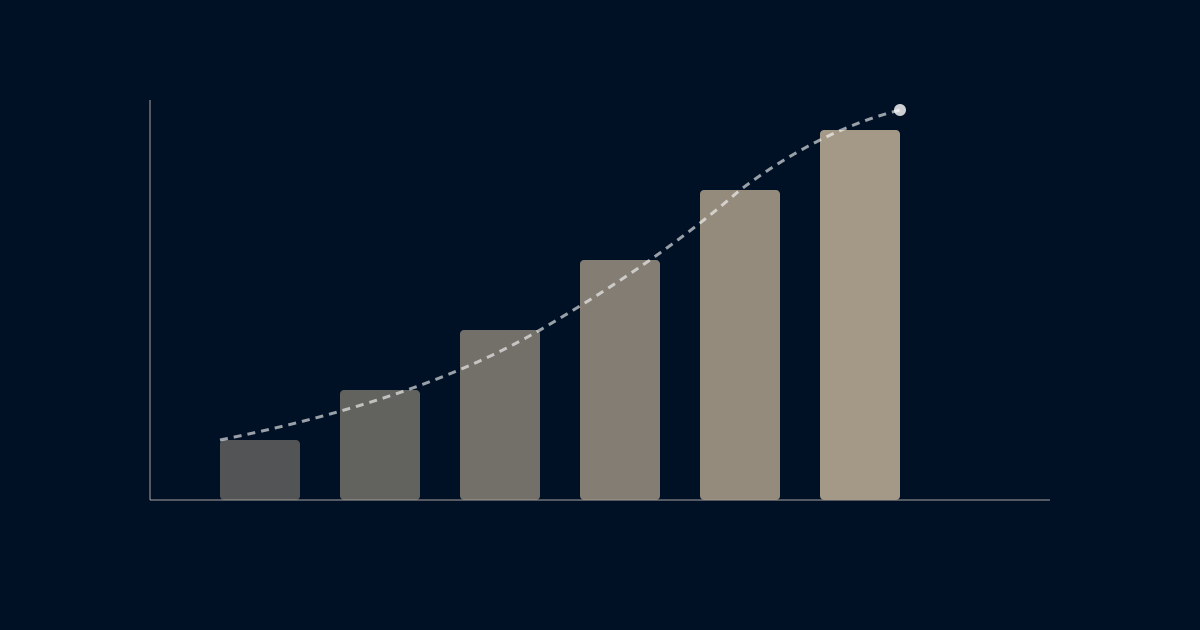
The pattern is clear: Vercel costs scale roughly linearly with traffic, with bandwidth as the steepest multiplier for content-heavy applications. It is the reason your hosting bill doubles the moment your product succeeds -- success and the invoice move together.
Where Vercel Genuinely Wins
Honest analysis requires naming the strengths. Vercel earns its position for specific use cases.
Next.js integration is unmatched. Vercel builds Next.js. Server components, incremental static regeneration (ISR), streaming, middleware, image optimization -- everything works on day one. No adapters, no compatibility layers, no edge cases. If your application is Next.js and you want zero deployment friction, Vercel is the simplest choice. Vercel's documentation on Next.js deployment reflects this tight coupling.
Developer experience is best-in-class for frontend teams. Preview deployments per pull request, instant rollbacks, build logs tailored to your framework, and a dashboard designed for frontend developers. The workflow from git push to production URL is as smooth as it gets.
The ecosystem is mature. Vercel has thousands of production deployments, a large community, extensive documentation, and well-tested infrastructure. When something goes wrong, you can find answers.
For small teams shipping Next.js, Vercel is often the right call. A 2-3 person team with moderate traffic will pay $40-100/month and get an excellent experience. The cost concerns in this article apply at scale -- not at launch.
The Flat-Rate Alternative Model
The pricing model Vercel uses -- metered bandwidth, metered compute, per-seat charges -- is one approach. It is not the only one.
Flat-rate hosting platforms charge a predictable monthly fee regardless of traffic. The economics work because they run on infrastructure with different cost structures. Global edge networks, for example, include generous bandwidth because their network architecture makes bandwidth nearly free at the infrastructure level.
Platforms built on edge infrastructure can offer:
- Zero bandwidth charges -- no per-GB overage fees
- Pricing decoupled from traffic -- the bill does not climb with every visitor
- No per-seat developer charges -- hosting cost is decoupled from team size
- Predictable monthly bills -- the same in January as in July
For a team running three production applications at 50,000 MAU, the difference is material. On Vercel Pro with realistic overages: $500-2,000/month. On a flat-rate edge platform: $150-300/month. Over a year, that is $4,200-$20,400 in savings -- enough to fund a contractor or an additional tool.
This is particularly relevant for applications serving images, video, or large assets. Bandwidth-heavy workloads are where metered pricing punishes you most and flat-rate pricing rewards you most. The cost of app sprawl is already high enough without hosting bills that spike unpredictably.
Performance at the Edge: A Cost-Adjacent Consideration
Pricing is not the only factor that changes at scale. Performance architecture matters too.
Vercel runs serverless functions on approximately 20 AWS regions worldwide. For users near those regions, latency is good. For users in cities without a nearby region -- across the Middle East, Africa, Southeast Asia, and parts of South America -- requests travel further.
Edge-native platforms run on global edge networks in 300+ cities. Serverless functions run in V8 isolates with sub-millisecond cold starts, compared to Vercel's typical 250ms+ cold starts on Lambda-based functions -- a gap we unpack in the hidden cost of serverless cold starts for global apps. The reach matters too: global apps need 300+ edge locations, not 20 regions.
For teams building applications with a global user base, this is not academic. A user in Jeddah served from a European AWS region experiences measurably higher latency than one served from a local edge node. When your application serves operations at the edge, infrastructure proximity directly affects user experience.
The performance difference does not matter for every application. A B2B SaaS used by 200 people in one country will not notice. A consumer platform serving users across dozens of countries will.
The No-Spending-Cap Problem
This deserves its own section because it catches teams by surprise.
On Vercel's Pro tier, there is no hard spending cap. You can configure alerts to notify you when spending exceeds a threshold, but you cannot prevent charges from accumulating. Vercel's spending management documentation confirms this: spend management is available on Enterprise, not Pro.
This means a DDoS attack, a bot crawl, a misconfigured webhook, or a viral social media post can generate significant overage charges before your team responds. The Pro tier is designed for growth -- which means it is also designed to bill for growth, whether that growth is intentional or not.
Enterprise tier includes spend management controls. But Enterprise starts at roughly $3,500/month. Paying $3,500/month for the privilege of capping your spending is a hard sell for a 10-person team.
Flat-rate platforms eliminate this category of risk entirely. A flat-rate application costs the same whether it serves 1,000 visitors or 1,000,000. The infrastructure absorbs the traffic; your bill does not change.
Who Should Stay on Vercel
Not every team should evaluate alternatives. Vercel is the right choice when:
- Your stack is Next.js and you want zero friction. Vercel's integration is genuinely superior for Next.js. The time saved on deployment configuration has real value.
- Your team is small (2-5 developers) and traffic is moderate. At $40-200/month, the developer experience premium is worth it.
- You need preview deployments per PR and your team relies on that workflow. Vercel's PR preview system is the best in the industry.
- You are pre-product-market-fit. At this stage, developer velocity matters more than hosting cost. Ship faster. Optimize costs later.
- Your application is bandwidth-light. SaaS dashboards with JSON APIs and minimal static assets stay well within Pro tier limits.
Who Should Evaluate Alternatives
The cost conversation becomes urgent -- and worth running through a developer decision framework for when to switch from Vercel -- when:
- Monthly Vercel bill exceeds $500. The cost differential with flat-rate platforms becomes material -- potentially $300-1,500/month in savings.
- Bandwidth is your largest overage category. Image-heavy, video-heavy, or download-heavy applications pay a structural tax on metered platforms.
- Your team is growing past 10 developers. At $20/dev/month, the per-seat charge alone is $200/month before any traffic costs.
- You serve users globally. Twenty AWS regions cannot match 300+ edge locations for latency-sensitive applications.
- You need spending predictability. Finance teams and bootstrapped startups need to know what hosting costs next month, not discover it after the invoice.
- You are building more than a frontend. If your product includes serverless APIs, scheduled jobs, real-time features, and custom business logic, building in the IDE and scaling through a unified platform may be more cost-effective than assembling Vercel + third-party services.
A Decision Framework
Use this to evaluate whether Vercel's pricing model still fits your trajectory.
Step 1: Calculate your true Vercel cost. Log into your Vercel dashboard. Look at the last 3 months of invoices. Add up base subscription, bandwidth overages, compute overages, and add-on services. If you are only looking at the $20/seat line item, you are looking at the wrong number.
Step 2: Project forward. If traffic doubles in 6 months (the goal for any growing product), what does your Vercel bill become? Bandwidth and compute scale linearly. Multiply your current overages by your growth multiplier.
Step 3: Compare total platform cost. Vercel is a deployment platform. It deploys your code. Auth, databases, email, business logic, monitoring, and AI are separate services with separate bills. Add those up. Then compare against unified platforms that bundle hosting with operational tools.
Step 4: Evaluate migration effort. Switching platforms has a real cost measured in engineering hours. For most frontend applications, the migration is 1-2 weeks -- the architecture is stateless, so you are moving code and environment variables, not data. Our step-by-step guide to migrating from Vercel to edge hosting walks the full path. Weigh the one-time migration cost against the ongoing monthly savings.
Step 5: Consider what you are building next. If your roadmap includes custom internal tools, serverless automations, or AI-powered features that need business context, evaluate whether those are cheaper to build on a deployment platform with third-party services or on a platform designed for custom apps.
The Bottom Line
Vercel is a good platform. At low traffic, it is a great deal. At scale, it is an expensive one -- not because the per-unit pricing is unreasonable, but because the metered model compounds across multiple dimensions simultaneously.
The honest summary:
- At 1,000 MAU: Vercel costs $50-120/month. Perfectly reasonable. Stay.
- At 10,000 MAU: Vercel costs $80-330/month. Watch your bandwidth.
- At 50,000 MAU: Vercel costs $230-1,180/month. Flat-rate alternatives save $100-900/month.
- At 100,000 MAU: Vercel costs $560-2,250/month. The savings from switching fund a full-time contractor.
The question is not whether Vercel is good. It is. The question is whether metered pricing aligns with your growth trajectory -- or whether you are paying an escalating tax on your own success.
Predictable costs let you plan. Metered costs make you react. At scale, the difference is not just financial -- it is strategic.
Want hosting costs that don't track your traffic? Waymaker Host includes bandwidth and meters only compute and storage -- see how Host is priced. Plus 20 operational tools and a platform to build custom software. Join the beta and see the difference.
Related reading: See the full all-in-one platform comparison for 2026, understand the real cost of app sprawl at $2,400 per employee, or learn why 2026 is the year of custom apps.
Frequently asked questions
Q: How much does Vercel actually cost at scale? It depends on traffic. Vercel runs $50-120/month at 1,000 MAU, $80-330 at 10,000, $230-1,180 at 50,000, and $560-2,250 at 100,000 -- because the metered model compounds bandwidth, compute, per-seat, and add-on charges at the same time.
Q: Why does my Vercel bill go up so fast? Production cost comes from five dimensions that scale independently: per-seat developer charges, bandwidth overages, serverless compute, edge middleware and add-on metering, and the jump to Enterprise. Bandwidth is the steepest multiplier for content-heavy applications.
Q: Does Vercel let me cap my spending? Not on the Pro tier. You can set spend notifications, but you cannot cap your bill -- so a traffic spike, bot crawl, or viral post can generate charges before you react. Spend management controls only arrive on Enterprise, which starts around $3,500/month.
Q: When should I consider leaving Vercel? The cost conversation becomes urgent when your monthly bill exceeds $500, bandwidth is your largest overage, your team grows past 10 developers, or you serve users globally. Walk it through a developer decision framework for when to switch from Vercel.
Q: Should small teams still use Vercel? Yes. For a 2-3 person team shipping Next.js with moderate traffic, Vercel costs $40-100/month and delivers a best-in-class developer experience. The cost concerns in this article apply at scale, not at launch.
Part of our guide to building and hosting what no one will build for you.
Frequently asked questions
- How much does Vercel actually cost at scale?
- It depends on traffic. Vercel runs $50-120/month at 1,000 MAU, $80-330 at 10,000, $230-1,180 at 50,000, and $560-2,250 at 100,000 -- because the metered model compounds bandwidth, compute, per-seat, and add-on charges at the same time.
- Why does my Vercel bill go up so fast?
- Production cost comes from five dimensions that scale independently: per-seat developer charges, bandwidth overages, serverless compute, edge middleware and add-on metering, and the jump to Enterprise. Bandwidth is the steepest multiplier for content-heavy applications.
- Does Vercel let me cap my spending?
- Not on the Pro tier. You can set spend notifications, but you cannot cap your bill -- so a traffic spike, bot crawl, or viral post can generate charges before you react. Spend management controls only arrive on Enterprise, which starts around $3,500/month.
- When should I consider leaving Vercel?
- The cost conversation becomes urgent when your monthly bill exceeds $500, bandwidth is your largest overage, your team grows past 10 developers, or you serve users globally. Walk it through a developer decision framework for when to switch from Vercel.
- Should small teams still use Vercel?
- Yes. For a 2-3 person team shipping Next.js with moderate traffic, Vercel costs $40-100/month and delivers a best-in-class developer experience. The cost concerns in this article apply at scale, not at launch.
About the Author

Waymaker Editorial
Stuart Leo founded Waymaker to solve a problem he kept seeing: businesses losing critical knowledge as they grow. He wrote Resolute to help leaders navigate change, lead with purpose, and build indestructible organizations. When he's not building software, he's enjoying the sand, surf, and open spaces of Australia.