Last Tuesday, one of your employees pasted a client's financial projections into ChatGPT. On Wednesday, another uploaded your draft partnership agreement into Claude. On Thursday, someone on the operations team asked Gemini to rewrite your pricing model using numbers pulled straight from the accounting system.
None of them told you. None of them thought twice about it. And none of them broke any rule you have on the books, because you don't have a rule for this yet.
This is shadow AI. Not a theoretical risk. Not an enterprise problem that doesn't apply to your 30-person company. It is happening inside your business right now, and the question is not whether to respond but how.
The enterprise playbook says ban it. Lock down the browsers. Block the URLs. Issue a company-wide policy memo that nobody reads. That approach fails in companies with 10,000 employees, and it fails harder in companies with 10.
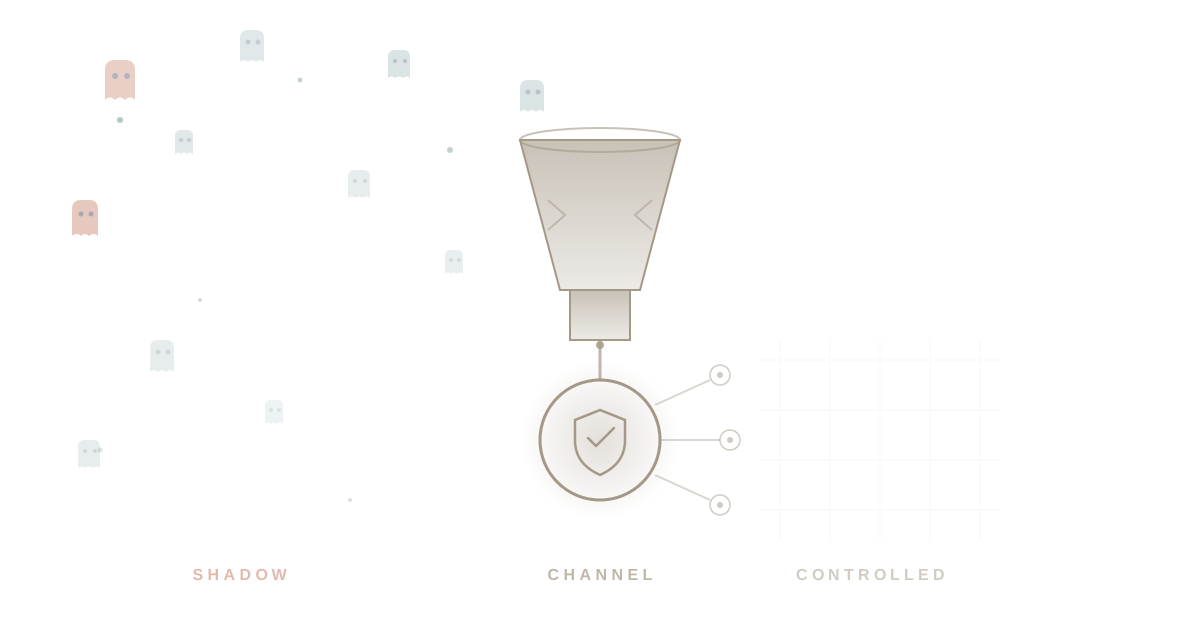
There is a better path: channel it.
What Shadow AI Actually Looks Like in a Small Business
Shadow AI gets discussed as though it is a corporate espionage problem. In reality, for small and mid-sized businesses, it looks far more mundane.
Your sales manager pastes a prospect's RFP into an AI chatbot to draft a faster response. Your bookkeeper uploads a spreadsheet of vendor invoices to get a summary. Your marketing coordinator feeds competitor URLs into an AI tool to generate positioning copy. Your operations lead asks an AI assistant to analyse staff utilisation data.
Every one of these actions sends business data — client names, financial figures, strategic plans, employee information — into a system you do not control, cannot audit, and have no contractual relationship with.
According to research from Gartner, the majority of AI tool adoption inside organisations happens without IT involvement. In small businesses without dedicated IT teams, that number approaches 100%. There is no approval process because there is no process at all. The true cost of this uncontrolled adoption compounds over time in ways most business owners never measure.
This does not mean your employees are careless. It means AI tools are genuinely useful, absurdly easy to access, and your business has not provided an alternative.
Why Banning AI Is the Wrong Response
The instinct to ban is understandable. If uncontrolled AI use creates risk, eliminate the AI. Simple.
Except it isn't.
A ban assumes you can enforce it. In a small business, enforcement means monitoring browser activity on every device, including personal phones and home laptops, that your employees use for work. It means policing tools that look like search engines, that operate inside browser tabs indistinguishable from any other website, and that your team genuinely believes are helping them do better work.
As the enterprise AI governance research consistently shows, blanket AI bans do not reduce AI usage. They drive it underground. Employees who found AI valuable do not stop using it — they stop telling you about it. The shadow gets darker.
Meanwhile, your competitors are not banning AI. They are embracing it. A Harvard Business Review analysis of knowledge worker productivity found that employees with access to AI tools completed tasks 30-40% faster than those without. Banning AI does not protect your business. It handicaps it while your competition accelerates.
The real question is not "how do we stop employees from using AI?" It is "how do we give them something better?"
The Acknowledge-Audit-Channel Framework
The path from shadow AI to strategic AI follows three steps. Each one builds on the last. Skip none of them.
Step 1: Acknowledge
Shadow AI exists in your business. Accept it.
This is not a failure of leadership. It is a natural consequence of AI tools being freely available and immediately useful. Your employees are not malicious — they are productive. They found tools that help them work faster and they used those tools.
The acknowledgement step requires honest conversation with your team. Not an interrogation. Not a punitive inquiry. An open discussion: "We know people are using AI tools for work. That makes sense — these tools are powerful. We want to make sure we are using them safely. Help us understand what you are using and why."
This conversation accomplishes two things. First, it surfaces the actual tools and use cases in play, which you need for the next step. Second, it signals to your team that you are not opposed to AI — you are opposed to uncontrolled AI. That distinction matters enormously for adoption of whatever comes next. The seven questions every business must answer about shadow AI provides a structured framework for this conversation.
Step 2: Audit
Once you know AI is being used, find out what data is going where.
The audit does not need to be a six-month security assessment. For a small business, it can be a structured week of discovery:
Map the tools. Which AI platforms are your employees using? ChatGPT, Claude, Gemini, Copilot, Perplexity, specialised tools for writing, coding, design? List them all.
Map the data. What types of information are going into these tools? Client data, financial records, employee information, strategic plans, proprietary processes, competitive intelligence? Categorise by sensitivity.
Map the frequency. Is this a daily workflow or an occasional experiment? Tools embedded in daily workflows create systemic risk. One-off experiments create isolated risk. The response should be proportional.
Map the gaps. Why are employees using shadow AI? What does the unapproved tool do that your approved systems cannot? Every shadow AI usage points to a gap in your technology stack.
The gap analysis is the most valuable output of the audit. It tells you exactly what an approved AI platform needs to deliver to replace the shadow tools. If your team uses ChatGPT primarily for drafting client communications, your approved solution needs to handle that use case at least as well. If they use it for data analysis, the solution needs analytical capability.
Without the audit, you are guessing at what your team needs. With it, you are building on evidence. The shadow AI compliance implications make this audit not just good practice but potentially a legal obligation, depending on your industry.
Step 3: Channel
This is where most advice stops at "create a policy." Policies are necessary but insufficient. You need to provide a better option.
Channelling shadow AI means giving your team an approved AI platform that meets the needs surfaced in your audit — one that is connected to your business data, governed by access controls, covered by audit trails, and architecturally designed so that sensitive information stays within systems you control.
The difference between shadow AI and channelled AI is not the AI itself. It is the infrastructure around it. Shadow AI means each employee has their own disconnected chatbot with no memory, no business context, and no guardrails. Channelled AI means a unified platform where AI operates within your business environment, understands your data relationships, and respects your access boundaries.
Consider what this looks like in practice. Instead of an employee copying client data from your CRM, pasting it into ChatGPT, getting a response, and then copying that response back into your system — a channelled approach routes the AI request through a platform API that already has secure access to your CRM data. The client information never leaves your controlled environment. The AI gets the context it needs. The employee gets the result they want. And you get an audit trail of every interaction. The comparison between shadow AI and approved platforms details exactly why this architectural difference matters.
What a Channelled AI Platform Looks Like
Not all "approved AI" is created equal. Buying enterprise ChatGPT licences is a step forward from the free tier, but it still operates as a disconnected chatbot. Your employees still copy-paste data in and out. You still lack business context. You still have fragmented AI usage across a dozen conversations nobody can find next week.
A genuinely channelled AI platform has five characteristics:
Connected to your business data. The AI can access the information it needs through secure APIs, not through employees manually copying data into chat windows. This eliminates the primary shadow AI risk — sensitive data leaving your controlled systems.
Governed by access controls. Different team members have access to different data. Your marketing coordinator should not be asking AI questions about payroll data. Role-based access ensures the AI respects the same boundaries as your other business systems.
Covered by audit trails. Every AI interaction is logged. Not for surveillance — for accountability and improvement. You can see what questions are being asked, what data is being accessed, and whether the AI is being used in ways that create risk. The CFO's guide to combating shadow AI explains why financial leaders increasingly demand this visibility.
Contextually aware. The AI understands your business, not just your question. It knows your projects, your goals, your team structure, your terminology. This makes it dramatically more useful than a generic chatbot, which is why employees actually want to use it instead of sneaking back to shadow tools.
Architecturally integrated. The AI is not a bolt-on feature. It is woven through your productivity tools — your task management, your goals, your documents, your data. This is the difference between "we have an AI chatbot" and "AI is part of how we work."
This is the approach WaymakerOS takes. One AI — routed through the platform API, connected to all 20 Commander tools, governed by your organisation's access controls, and covered by enterprise audit trails. Every AI request flows through a controlled channel. No data leaves your environment to train someone else's model. The app sprawl problem that shadow AI creates — dozens of disconnected tools, each with their own login, their own data silo, their own security posture — collapses into a single, governed platform.
The Cost of Inaction
Every week you wait, the shadow AI footprint in your business grows. More data flows into uncontrolled systems. More workflows become dependent on tools you cannot audit. More risk accumulates in places you cannot see.
The direct costs are documented: data breaches involving AI-exposed information carry average penalties that can devastate a small business. But the indirect costs are often larger. Client trust eroded when they learn their data was pasted into a consumer AI tool. Competitive advantage lost when proprietary strategies end up in training datasets. Regulatory exposure when your industry's compliance requirements collide with your employees' AI habits.
The cost of channelling AI is measurable and manageable. A platform subscription, an afternoon of setup, a team conversation about how AI fits into your workflow. The cost of not channelling it is the accumulated risk of every uncontrolled interaction, compounding daily, until something breaks.
Start This Week
You do not need a six-month digital transformation initiative. You need three conversations and one decision.
Conversation one: Tell your team you know AI is being used and you support it — within a framework. Ask what tools they use and why. Listen without judgement.
Conversation two: Review the audit findings with your leadership team. Identify the highest-risk data flows and the highest-value use cases. These are your priorities.
Conversation three: Evaluate approved platforms against those priorities. The right platform is not the one with the most features. It is the one your team will actually use because it solves the problems they were already trying to solve with shadow AI.
The decision: Choose a channelled AI platform and commit to rolling it out within 30 days. Not 90. Not "next quarter." The shadow AI risk grows every day you deliberate.
Shadow AI is not the problem. It is the symptom. The problem is that your business has not yet provided a sanctioned, connected, contextually aware AI platform that is genuinely better than the free tools your employees found on their own.
Build that channel, and the shadow disappears.
The unified productivity approach replaces fragmented, uncontrolled AI usage with a single platform where intelligence is built into the tools your team already uses daily. The context engineering principles behind this approach explain why connected AI — AI that understands your business — outperforms disconnected chatbots every time.
Your employees are already using AI. The only question is whether it works for your business or outside of it. Channel the shadow, and you turn a hidden risk into a visible advantage.
About the Author

Stuart Leo
Stuart Leo founded Waymaker to solve a problem he kept seeing: businesses losing critical knowledge as they grow. He wrote Resolute to help leaders navigate change, lead with purpose, and build indestructible organizations. When he's not building software, he's enjoying the sand, surf, and open spaces of Australia.