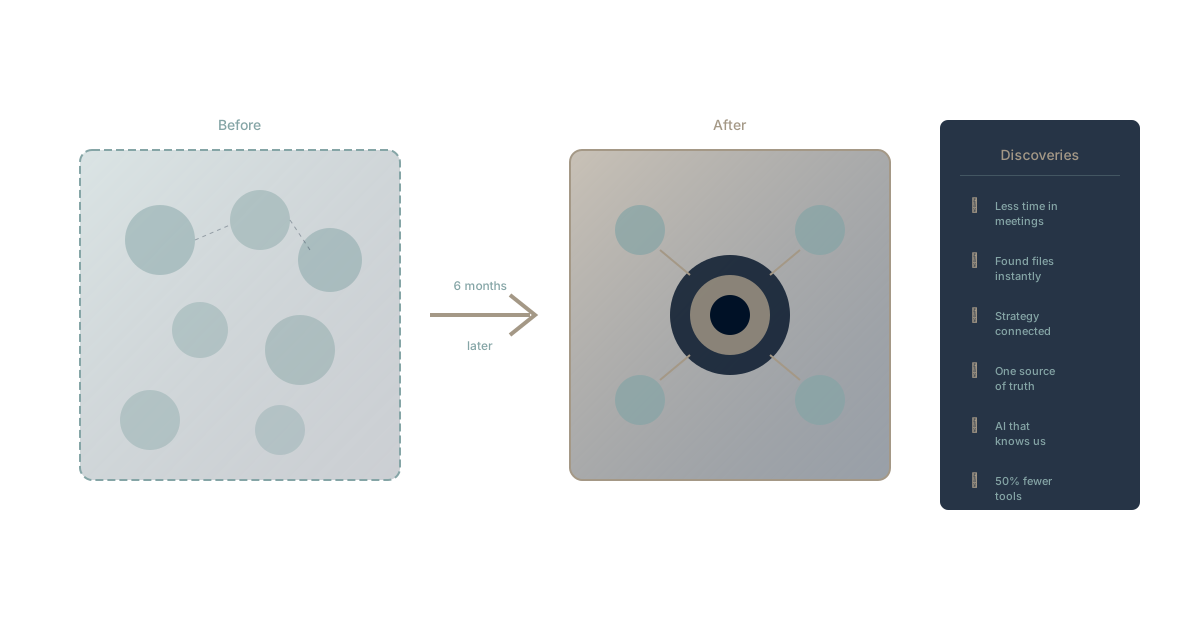
Six months after leaving Google Workspace, teams report consistent surprises—some positive, some unexpected, all educational.
What actually happens after migration?
Based on patterns from organizations that made the transition, here's what teams discover after leaving Google Workspace.
Discovery 1: The Workspace Dependency Was Real
What Teams Expected
"Workspace is just email and docs—we'll barely notice the difference."
What Teams Found
Google Workspace integration runs deeper than casual usage suggests:
The spreadsheet reality: Google Sheets formulas, formatting, and collaboration features don't translate perfectly. Teams discover workflows dependent on Sheets-specific features.
The forms dependency: Google Forms was being used everywhere—feedback, surveys, event registration. Alternatives exist but require migration and retraining.
The Drive structure: Google Drive's organization (or lack of organization) was at least familiar chaos. New chaos requires relearning.
The Gmail habits: Keyboard shortcuts, label systems, search operators—muscle memory takes time to rebuild.
The Lesson
Audit dependencies before assuming migration is simple. The simple-seeming tool often has deep roots.
Discovery 2: The Problems Weren't All Workspace's Fault
What Teams Expected
"Once we're off Workspace, things will be better."
What Teams Found
Some problems traveled with them:
Disorganization followed: Teams who had chaotic Drives often created chaotic alternatives. The tool didn't cause the chaos—habits did.
Meeting culture persisted: Meeting overload isn't a Google Meet problem. It's a cultural problem that moved platforms.
Communication patterns stayed: Whether in Gmail or Outlook, email overload persists if habits don't change.
Knowledge silos remained: Knowledge management problems exist at the organizational level, not the tool level.
The Lesson
Migration without process change changes tools, not outcomes. Address root causes, not just symptoms.
Discovery 3: Things Got Better in Unexpected Ways
The Positive Surprises
Integration depth: Microsoft 365 environments often provide deeper integration than expected—calendar, files, Teams working together more tightly.
Enterprise features: Security, compliance, and admin capabilities often exceeded Workspace offerings.
Familiarity dividend: For organizations with Microsoft backgrounds, returning to familiar tools boosted productivity faster than expected.
Platform consolidation: Some teams discovered they could eliminate other tools by fully using their new platform.
What Teams Said
"We didn't realize how much we were working around Workspace limitations until we didn't have to anymore."
"Enterprise features we thought we needed expensive add-ons for were included."
"Training went faster because people remembered Office from previous jobs."
The Lesson
Honest comparison happens post-migration. Pre-migration expectations often underestimate both challenges and benefits.
Discovery 4: Things Got Worse in Unexpected Ways
The Negative Surprises
Learning curves compound: When email AND files AND meetings all change simultaneously, cognitive load spikes.
Collaboration differences: Real-time collaboration in Google Docs really was smoother. Alternatives improved but felt different.
Mobile experience: Google's mobile apps often worked better than alternatives, especially for mixed device environments.
SharePoint complexity: Organizations moving to Microsoft discovered SharePoint's notorious confusion firsthand.
What Teams Said
"We underestimated how much retraining 'simple' things would require."
"Real-time editing just worked better in Docs. We adjusted but miss it."
"SharePoint... we should have planned more for SharePoint."
The Lesson
Honest migration planning accounts for downgrades alongside upgrades. No platform is better at everything.
Discovery 5: The Hidden Costs Were Real (Both Ways)
Workspace's Hidden Costs Were Real
The TCO analysis proved accurate:
Integration tax decreased: Fewer tools needed when platform is more complete.
Context switching reduced: Less bouncing between applications for related tasks.
Admin overhead changed: Different, sometimes better, sometimes more complex.
But So Were Migration Costs
Productivity dip: Real and lasted longer than expected for some teams.
Training investment: Formal and informal training consumed significant time.
Data cleanup: Migration revealed (and required addressing) years of accumulated mess.
Process redesign: Many workflows needed redesign, not just tool substitution.
The Lesson
Both staying and leaving have costs. The question is which costs better align with strategic direction.
Discovery 6: AI Capability Shifted
The AI Reality Check
Organizations that migrated discovered AI capability is platform-dependent:
Google AI capabilities left behind: Workspace AI features don't transfer.
New AI capabilities available: Microsoft Copilot or alternative AI, with different strengths.
Neither provided organizational memory: The fundamental context engineering problem wasn't solved by switching platforms.
Unified platforms differed: Organizations moving to unified work platforms found AI could access more contextual data.
What Teams Said
"We lost Duet AI features but gained Copilot features. Different, not clearly better."
"The AI isn't the magic we hoped for on any platform."
"The real AI unlock came from having our work data in one place."
The Lesson
AI capability follows data architecture. Platform choice matters, but data unification matters more.
Discovery 7: Culture Change Matters Most
The Cultural Element
The most successful post-Workspace organizations made cultural changes alongside tool changes:
Documentation culture: Commitment to writing things down, regardless of tool.
Async communication: Reducing meeting dependency and real-time pressure.
Knowledge management: Actual investment in organizing, not just storing.
Continuous improvement: Ongoing optimization, not just migration and forget.
The Least Successful Transitions
Organizations that struggled post-migration:
- Expected tools to solve cultural problems
- Didn't invest in change management
- Rushed migration without preparation
- Failed to address underlying process issues
The Lesson
Migration is an opportunity for organizational change. Organizations that treat it as just a tool swap miss the opportunity.
What Successful Teams Recommend
Pre-Migration
- Honest assessment: What are you actually trying to solve?
- Root cause analysis: Is this a tool problem or a process problem?
- Clear success metrics: How will you know migration succeeded?
- Change management investment: Budget time and resources for human factors.
During Migration
- Phased approach: Don't change everything at once.
- Support resources: Help available when people struggle.
- Feedback channels: Listen and adapt as issues emerge.
- Patience: Productivity dips are normal; panic isn't helpful.
Post-Migration
- Optimization period: Plan for 3-6 months of settling in.
- Process review: What workflows need redesign?
- Tool consolidation: What other tools can now be eliminated?
- Lessons documentation: Capture what was learned.
Experience Platform Transition Done Right
Considering leaving Google Workspace? Waymaker Commander offers not just a destination but a consolidation opportunity—unifying work management, documents, and strategy where traditional suites keep them separate.
The result: Migration that simplifies rather than substitutes. Fewer tools, not different tools.
Register for the beta and explore what post-Workspace productivity can look like.
What teams discover after leaving Workspace depends on what they do, not just which tool they choose. Migration reveals dependencies, surfaces organizational issues, and creates opportunity for genuine improvement—if approached as organizational change rather than tool replacement. The lessons from organizations that made the transition can guide those considering it. Learn more about migration planning and explore how platform consolidation creates lasting value.
The Waymaker Editorial team researches workplace software. This synthesis captures common patterns in what teams discover after leaving Google Workspace.
Part of our guide to leaving google workspace.
About the Author

Waymaker Editorial
Stuart Leo founded Waymaker to solve a problem he kept seeing: businesses losing critical knowledge as they grow. He wrote Resolute to help leaders navigate change, lead with purpose, and build indestructible organizations. When he's not building software, he's enjoying the sand, surf, and open spaces of Australia.