Open your laptop on a Monday morning. Check the booking system. Jump to the channel manager. Copy a guest name into the CRM. Paste an amount into the accounting software. Reply to a review on TripAdvisor. Update the team in Slack. Upload an invoice to Google Drive.
You have not done any actual work yet. You have spent 45 minutes moving data between systems that refuse to talk to each other.
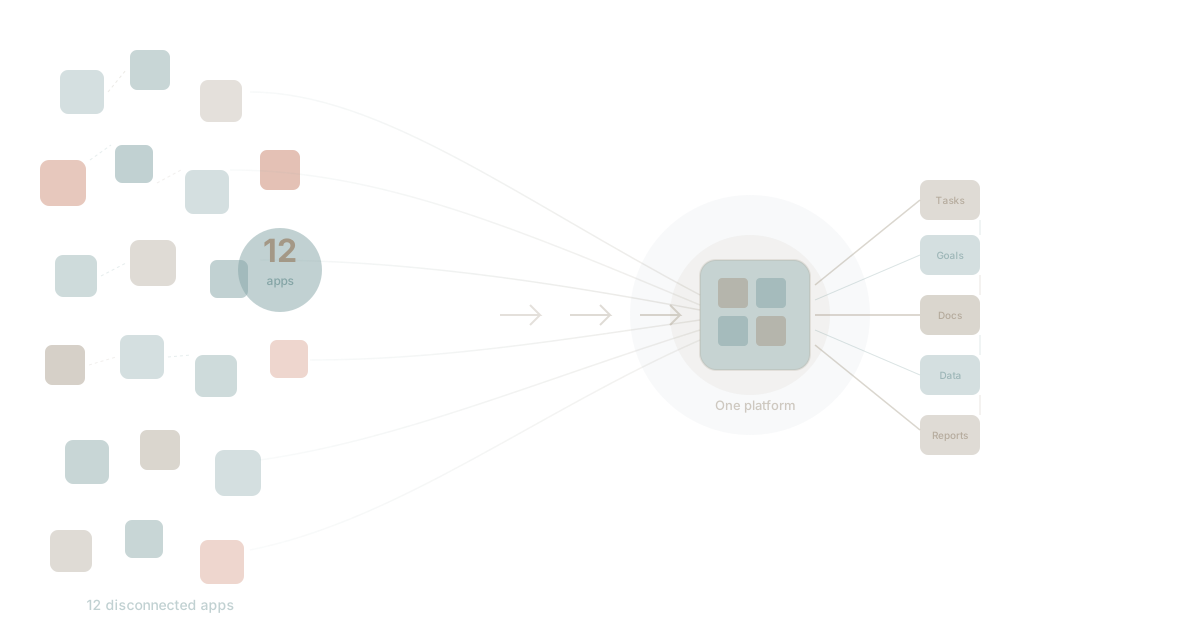
Welcome to the tourism industry's dirty secret: every operator runs on a patchwork of 12 or more disconnected apps, and nobody is counting the real cost.
The Typical Tourism Tech Stack
Walk into any tourism business with 5 to 50 employees and you will find a remarkably similar pattern. The tools differ by name, but the fragmentation is universal.
The Core 12
1. Booking System — Rezdy, FareHarbor, Peek, or Bokun for tour operators. Little Hotelier, Cloudbeds, or RMS for accommodation providers. This is the heart of the operation and the one system nobody questions.
2. Channel Manager — SiteMinder, Rentals United, or Lodgify. Distributes availability across Booking.com, Expedia, Airbnb, Viator, and GetYourGuide. Runs alongside the booking system but rarely shares data cleanly with anything else.
3. Property Management System (PMS) — For accommodation providers, this is often a separate layer managing housekeeping, maintenance, and room assignments. Mews, Opera, or Guesty each add another login.
4. Accounting Software — Xero, QuickBooks, or MYOB. Booking revenue flows here eventually, but "eventually" usually means someone manually reconciles numbers every week.
5. Email and Calendar — Google Workspace or Microsoft 365. Guest correspondence, team scheduling, supplier coordination. The oldest tool in the stack and still the most used.
6. CRM — HubSpot, Salesforce, or more commonly a spreadsheet pretending to be a CRM. Guest history, corporate client relationships, agent contacts. Rarely connected to the booking system in any meaningful way.
7. Website and CMS — WordPress, Squarespace, or Webflow. The storefront that generates direct bookings but lives in its own content universe, disconnected from operational data.
8. Social Media Management — Hootsuite, Later, or Buffer. Scheduling posts, tracking engagement, responding to comments. A content silo that never touches the booking pipeline.
9. Review Management — Reputation.com, ReviewPro, or manual monitoring of TripAdvisor, Google Reviews, and Booking.com reviews. Guest feedback trapped in a system that does not connect to guest profiles.
10. Team Communication — Slack, Microsoft Teams, or WhatsApp groups. Operational coordination that generates decisions and context, then buries it in chat history nobody can search.
11. Document Storage — Google Drive, Dropbox, or OneDrive. Contracts, SOPs, training materials, supplier agreements. The digital filing cabinet nobody can navigate.
12. Payment Processing — Stripe, Square, or a bank terminal. Transaction data that lives separately from both accounting and booking systems, creating reconciliation headaches.
That is twelve applications at minimum. Many operators also use separate tools for staff rostering (Deputy, When I Work), task management (Trello, Asana), guest messaging (Akia, Duve), and reporting (Tableau, Google Data Studio). The real count often reaches 15 to 18.
This is the app sprawl crisis playing out in one of the world's largest industries.
The Real Cost Nobody Calculates
Subscription Fees: The Visible Tip
The direct software costs are the easiest to measure and the least concerning part of the problem.
A typical 15-person tour operator pays roughly:
| Application | Monthly Cost |
|---|---|
| Booking system | $200-400 |
| Channel manager | $100-300 |
| Accounting | $50-80 |
| Email/calendar | $90 (15 seats) |
| CRM | $0-150 |
| Website/CMS | $30-80 |
| Social media tool | $50-100 |
| Review management | $50-200 |
| Team communication | $0-120 |
| Cloud storage | $15-90 |
| Payment processing | Percentage-based |
| Task management | $0-100 |
| Total | $585-1,620/month |
That is $7,000 to $19,400 per year in subscription fees alone. Not catastrophic for a viable business. But subscriptions are only 30-40% of the real cost according to McKinsey research on technology adoption in travel and logistics.
The Integration Tax: Where Money Disappears
The painful cost is invisible. It hides in the hours your team spends being the human glue between systems.
Data re-entry: A booking comes through FareHarbor. Someone copies the guest name, email, and payment amount into Xero. Someone else adds the guest to the CRM spreadsheet. A third person logs the booking in the weekly report. The same data entered three times by three people.
According to Gartner's research on IT operations, businesses with fragmented application landscapes spend 20-30% of operational staff time on data transfer and reconciliation activities. For a 15-person tourism business where 8 staff members handle administrative tasks, that is 1.6 to 2.4 full-time-equivalent roles consumed by moving data between systems.
At $55,000 average salary in the tourism sector, you are paying $88,000 to $132,000 per year in hidden integration costs — seven times more than your software subscriptions.
The Context Switching Penalty
Every time a team member alt-tabs from the booking system to accounting software, their brain pays a cognitive tax. Research published in the Journal of Experimental Psychology shows that switching between applications costs 15 to 23 minutes of refocused attention per switch.
In tourism operations, the switching is relentless. A front desk agent at a boutique hotel might toggle between PMS, email, channel manager, and guest messaging 40 to 60 times per shift. At even a conservative 5-minute cognitive penalty per significant switch, that is hours of productive capacity lost daily.
The guest standing at the counter notices. The email that sits unanswered for three hours notices. The booking error that slips through because someone was mid-switch definitely notices.
The Error Cost
Disconnected systems breed errors. When booking data does not automatically flow to accounting, discrepancies emerge. When guest preferences stored in the CRM never reach the operations team, service suffers. When a review mentions a specific incident but the operations log lives in a different system, the feedback loop breaks.
A 2024 study by Skift Research found that tourism businesses with fragmented tech stacks experience 3.2 times more operational errors than those with integrated systems. Each error carries a cost: refund processing, guest recovery, staff time investigating, and the invisible cost of reviews that drop from 5 stars to 3.
For a property management company handling 50 vacation rentals, even a 2% booking error rate means one mistake per week. Each mistake costs an average of $150 to $400 in direct resolution costs, plus immeasurable reputation damage.
Three Businesses, Three Versions of the Same Problem
The 15-Person Tour Operator
Sarah runs adventure tours in Queensland. Her team uses Rezdy for bookings, Xero for accounting, Mailchimp for marketing emails, WhatsApp for team coordination, and Google Sheets as a CRM. Every Friday afternoon, her operations manager spends three hours reconciling booking revenue in Xero against Rezdy reports. Guest information lives in four different places. When a repeat customer books, nobody knows they have been before unless someone happens to remember their name.
Sarah's problem is business amnesia. Her organisation forgets what it knows because knowledge is scattered across disconnected systems.
The Boutique Hotel
Marcus manages a 28-room boutique hotel in Byron Bay. His stack includes Little Hotelier for PMS, SiteMinder for channel management, Xero for accounting, Slack for staff communication, TripAdvisor and Google for reviews, Deputy for staff rostering, and Canva plus Later for social media content. His front desk team spends the first hour of every shift checking five different systems to understand the day's operations. Guest preferences noted during one stay never surface during the next.
Marcus's problem is knowledge silos. Every system holds a fragment of the truth, but nowhere holds the complete picture.
The Property Management Company
Rachel manages 120 short-term rental properties across three coastal towns. She uses Guesty for property management, Pricelabs for dynamic pricing, Breezeway for turnovers and maintenance, QuickBooks for accounting, Slack for team coordination, and Asana for task tracking. Her cleaning teams get turnover schedules from Breezeway, but special guest requests logged in Guesty never reach them. Maintenance issues reported in Breezeway do not automatically block bookings in Guesty. Revenue data in QuickBooks never matches Guesty reports without manual adjustment.
Rachel's problem is process fragmentation. Work that should flow automatically from booking to fulfilment to accounting requires human intervention at every handoff point.
What the Cost Actually Looks Like
Let us calculate the true annual cost for Sarah's 15-person tour operation:
| Cost Category | Annual Cost |
|---|---|
| Software subscriptions (12 apps) | $12,000 |
| Data re-entry labour (1.8 FTE equivalent) | $99,000 |
| Error resolution (2% booking error rate) | $15,600 |
| Context switching productivity loss | $36,000 |
| Integration maintenance (Zapier, manual) | $4,800 |
| Onboarding overhead (new staff learning 12 tools) | $8,000 |
| Total | $175,400 |
The software subscriptions — the number most operators focus on — represent less than 7% of the total cost. The other 93% is invisible, embedded in labour, errors, and lost productivity.
For a business generating $1.2 million in annual revenue, $175,000 is 14.6% of gross revenue consumed by application fragmentation. That is the difference between a business that merely survives and one that thrives.
Why "Just Integrate Everything" Fails
The obvious response is integration. Connect the apps with Zapier, Make, or custom APIs. Build the bridges.
Tourism operators have tried. The problem is structural.
Integration fragility: Tourism systems update frequently. A Rezdy API change breaks the Zapier connection to Xero. Nobody notices for two weeks. Two weeks of unreconciled revenue creates a bookkeeping nightmare.
Partial data transfer: Integrations typically move specific data fields. A Zapier connection might sync booking amounts to accounting but miss the guest dietary preferences that should reach the operations team. You end up with partially connected systems that create false confidence.
Multiplicative complexity: Connecting 12 apps pairwise requires up to 66 integration points. Even connecting them through a hub requires 12 connections, each with its own maintenance burden. When you want to consolidate your tech stack, bolting integrations onto fragmented tools is not consolidation — it is expensive wallpaper over structural cracks.
Cost escalation: Zapier's pricing scales with usage. A tourism business running 50 to 100 automated tasks across 12 apps quickly reaches $100 to $200 per month in middleware costs alone, on top of the subscription fees for each individual app.
The Alternative: A Platform That Connects the Work
The solution is not more integration. It is less fragmentation.
Imagine a unified productivity platform where a booking automatically creates a task for the operations team, generates an invoice in the accounting module, adds the guest to the CRM with their full history, and triggers a follow-up workflow for review collection — all without a single copy-paste or manual data transfer.
This is not theoretical. It is the direction the industry must move, and platforms that unify operations are already emerging. When your project management software is the same platform that handles your goals, documents, and team coordination, the integration tax disappears because there is nothing to integrate.
The build vs buy question for tourism operators has shifted. You no longer need to choose between expensive custom development and living with 12 disconnected tools. A platform approach gives you the foundation — tasks, goals, documents, communication, reporting — and lets you build custom apps for the tourism-specific workflows that no generic tool covers.
A tour operator could build a booking-to-invoice automation that matches their exact process. A hotel could build a guest preference system that surfaces the right information at the right moment. A property manager could build a turnover workflow that connects cleaning, maintenance, inspection, and guest communication in a single flow.
The key insight is this: every tourism business has processes that are unique to how they operate. Those processes currently live in the gaps between 12 apps, managed by humans doing manual data transfers. A platform that lets you build within it — not just use pre-built features — closes those gaps permanently.
Five Steps to Escape the 12-App Trap
Step 1: Map Your Actual Stack
List every application your team uses. Not just the ones IT approved — every tool, every login, every spreadsheet pretending to be software. Most operators discover they use more apps than they thought. This is where context engineering starts: understanding the full landscape before making changes.
Step 2: Trace the Data Flows
For your three most common workflows (booking to fulfilment, guest inquiry to conversion, month-end reporting), map every system the data touches and every human handoff point. Count the manual transfers. Time them. This reveals where the real cost hides.
Step 3: Calculate Your True Cost
Use the framework above. Add subscription fees, data re-entry labour, error resolution costs, context switching losses, and integration maintenance. The total will be larger than expected. Share it with your team. The number creates urgency.
Step 4: Identify Your Platform Requirements
Not every app in your stack needs replacing simultaneously. Identify which applications handle your core operational workflows and which are peripheral. The core operational cluster — booking, tasks, accounting, CRM, communication, documents — is where fragmentation costs the most and where platform consolidation delivers the fastest return.
Step 5: Set OKR Goals for the Transition
Define measurable outcomes. "Reduce data re-entry time by 60% within 90 days" is more useful than "consolidate our tech stack." Setting OKR goals for the transition keeps the team focused on outcomes rather than getting lost in tool evaluation.
The Industry Is Shifting
Tourism has always been an industry of thin margins and high operational complexity. The businesses that thrive are the ones that convert operational efficiency into guest experience and profitability.
For the past decade, the answer was "buy the best tool for each job." That answer created the 12-app trap. The next decade belongs to operators who recognise that the best tool for every job is a platform where the jobs are connected.
The real question is not which 12 apps to use. The real question is why your booking data, guest relationships, team tasks, financial records, and operational workflows still live in 12 separate worlds — and what it would mean for your business if they did not.
Stuart Leo is the author of Resolute and founder of Waymaker. Having worked with tourism and hospitality businesses across Australia, he built WaymakerOS to solve the fragmentation problem he saw in every operation he advised.
About the Author

Stuart Leo
Stuart Leo founded Waymaker to solve a problem he kept seeing: businesses losing critical knowledge as they grow. He wrote Resolute to help leaders navigate change, lead with purpose, and build indestructible organizations. When he's not building software, he's enjoying the sand, surf, and open spaces of Australia.