It is 9:14 AM at a mid-size accounting firm. A senior consultant opens her laptop and begins the routine that defines her day.
She checks email for client messages. Switches to the CRM to log a conversation from yesterday. Opens the project management tool to update task status. Moves to the time-tracking app to record yesterday's hours she forgot to enter. Pulls up a shared document to review deliverables. Jumps to the invoicing platform because a client queried a line item. Then back to email, because three new messages arrived while she was cycling through five other applications.
It is now 9:47 AM. She has not started any billable work.
This is the daily reality inside consulting firms, accounting practices, and law offices worldwide. Professional services firms — the businesses that literally sell their people's time — are haemorrhaging that time to the friction between disconnected tools.
The Professional Services Tool Loop
Professional services firms have a uniquely painful relationship with app sprawl. Unlike product companies, where the product itself generates revenue, services firms monetise human attention. Every minute spent switching between applications is a minute that cannot be billed, cannot be applied to client work, and cannot generate revenue.
Yet these firms typically operate across more tools than almost any other industry segment.
Here is the standard daily loop:
- Email — Client communication, internal updates, scheduling
- CRM — Client records, pipeline tracking, relationship history
- Project management — Engagement tracking, task assignment, deadlines
- Time tracking — Billable hours, utilisation rates, timesheet submission
- Document management — Proposals, deliverables, contracts, templates
- Invoicing and billing — Time-to-invoice conversion, expense tracking
- Back to email — Because everything generates notifications
That is seven distinct applications, each with its own login, its own interface conventions, its own notification system, and its own version of reality. And that loop does not include Slack or Teams, video conferencing, internal knowledge bases, or the spreadsheets people maintain because no single tool gives them the full picture.
The knowledge silos this creates are staggering. A partner asks about a client relationship and the answer lives across four systems: recent emails in Outlook, billing history in the invoicing tool, project status in Monday.com, and meeting notes in a Google Doc that may or may not have been shared with the right people.
The 5-Hour Calculation
Research from Harvard Business Review on knowledge worker productivity and Cal Newport's work on deep focus consistently show that context switching imposes far higher costs than most organisations estimate.
Here is the conservative arithmetic for professional services:
Significant context switches per day: Professional services employees make approximately 25-30 meaningful application switches daily. Not the hundreds of micro-switches that inflate some statistics — but the kind where you close one mental model and open another.
Cognitive recovery per switch: Gloria Mark's research at UC Irvine established that recovering full cognitive focus after a switch takes significant time. For professional work requiring concentration — analysing financials, drafting legal briefs, structuring consulting recommendations — the recovery is steeper than average. Even at a conservative 4 minutes of diminished productivity per meaningful switch, the numbers accumulate.
The weekly total:
- 28 meaningful switches per day x 4 minutes recovery = 112 minutes per day
- 112 minutes per day x 5 days = 560 minutes per week
- 560 minutes = 9.3 hours of diminished productivity per week
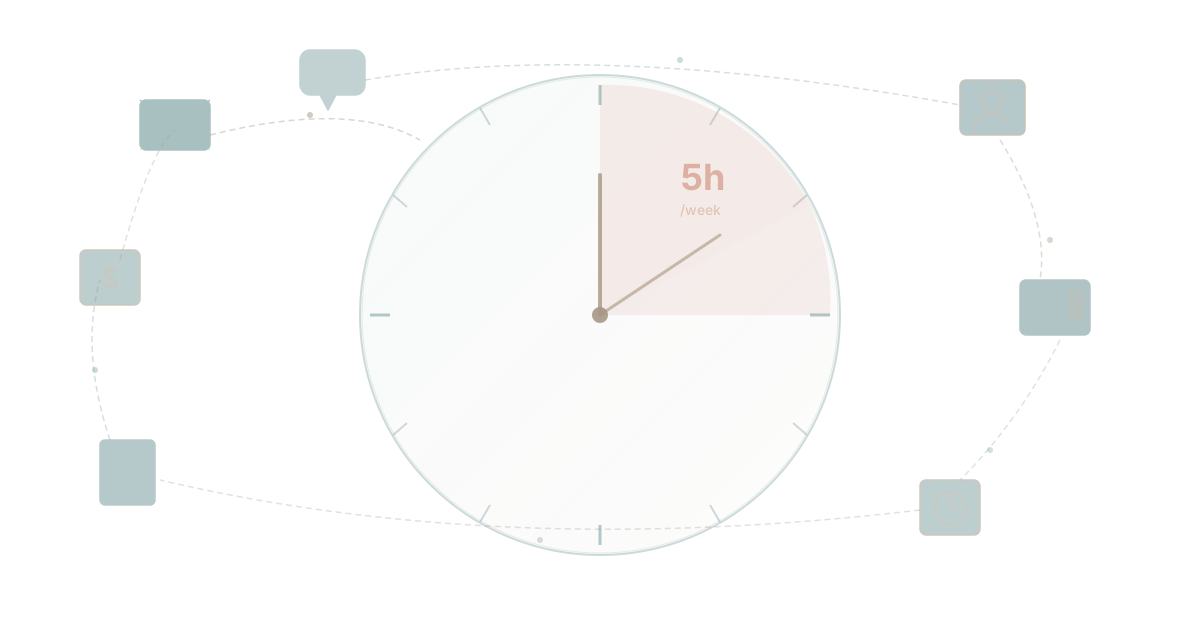
Even if you halve that estimate to account for variation, you arrive at 4.7 hours per week — effectively the 5 hours that multiple workplace studies corroborate.
For a firm of 50 professionals billing at $200/hour:
- 5 hours lost x 50 people x 48 working weeks = 12,000 hours per year
- 12,000 hours x $200 billable rate = $2.4 million in unrealised revenue annually
That is not a cost centre estimate. That is revenue the firm could have generated if its people were doing client work instead of navigating between applications.
Why Professional Services Firms Are Uniquely Vulnerable
Time Is Literally the Product
A software company can absorb tool-switching overhead because its product generates revenue independent of individual employee minutes. A consulting firm cannot. Every hour lost to administrative friction is an hour that could have been billed to a client. The relationship between time spent and revenue generated is direct and measurable.
This is why utilisation rate — the percentage of available hours that are billable — is the defining metric of professional services. Most firms target 65-75% utilisation. The gap between target and reality is often filled by exactly the kind of tool-switching overhead described here.
Client-Facing Work Demands Deep Focus
Writing a consulting recommendation, preparing an audit opinion, or drafting a legal brief requires sustained concentration. These are not tasks that survive well in the fragmented attention environment that context switching creates.
Cal Newport's research on deep work, detailed in his book and subsequent academic work, demonstrates that cognitively demanding work requires uninterrupted blocks of 60-90 minutes to reach full productive capacity. Professional services work is almost entirely cognitively demanding. The fragmented environment created by seven or more disconnected tools makes sustained focus nearly impossible.
Compliance Creates Additional Friction
Accounting, legal, and financial consulting firms face regulatory requirements that add tool layers. Document retention policies, audit trails, conflict-of-interest checks, and client confidentiality requirements often mean additional systems, additional logins, and additional switching.
A tax partner preparing a complex return might interact with the tax preparation software, the client's financial records (accessed through a secure portal), the firm's research database, internal review workflows, and the document management system — all while still doing the seven-step email-to-invoicing loop described above.
The Compounding Effect: Business Amnesia
The switching problem does not just cost time in the moment. It creates a deeper structural issue: business amnesia.
When client knowledge is fragmented across email, CRM, project management, and billing systems, the firm's institutional memory degrades. A partner retires and decades of client relationship context disappears because it was distributed across inboxes and personal notes. A senior consultant leaves and the nuances of ongoing engagements — the preferences, the history, the unwritten agreements — leave with them.
This is the knowledge silos problem at its most expensive. Professional services firms sell expertise and relationships, yet the systems meant to support those relationships fragment them beyond recovery.
What the Research Actually Shows
The connection between fragmented tooling and diminished performance is well-documented:
- Harvard Business Review research on attention management finds that knowledge workers spend 28% of their workweek managing email alone, before touching any other application.
- McKinsey's research on professional productivity identifies tool fragmentation as a primary contributor to the gap between potential and actual utilisation in services firms.
- Gartner's IT research consistently reports that the average enterprise uses 130+ SaaS applications, with professional services firms trending higher due to client-specific tool requirements.
- Cal Newport's deep work research demonstrates that the minimum viable block for cognitively demanding work is 60-90 minutes — a block that tool sprawl involving 47+ apps makes extraordinarily difficult to protect.
The pattern is consistent: more tools, more switching, less deep work, lower output quality, lower utilisation, lower revenue.
The Consolidation Imperative
The solution is not "try harder to focus." The solution is structural. You consolidate the tech stack without losing features.
Professional services firms need a platform approach that unifies the core operational loop — projects, tasks, time, documents, goals, and communication context — into a single environment. Not by cramming features into a lowest-common-denominator tool, but by building an integrated platform where context flows between capabilities without requiring the human to be the integration layer.
This is the build vs. buy platform decision that every services firm will face in 2026 and beyond. The firms that solve it will reclaim those 5 hours per employee per week. The firms that do not will continue paying the invisible tax.
What Consolidation Looks Like in Practice
Consider the 9:14 AM scenario rewritten on a unified platform:
The senior consultant opens her workspace. Client messages are surfaced alongside the active project. Time tracking is contextual — she logs hours against the task she is working on, not in a separate application. The document she needs is linked to the project phase. The invoice query is visible as a comment on the relevant engagement. She reviews, responds, and begins billable work by 9:20 AM.
Same work. Same information. No switching. No context loss. No 33-minute tax before the real day begins.
The CIO's Role
For larger professional services firms, this is fundamentally a tool rationalisation challenge. It requires auditing the current stack, mapping the switching patterns, quantifying the cost in unrealised billable hours, and building the case for platform consolidation.
The argument is straightforward: the firm is paying for tools that collectively cost more in lost productivity than they deliver in functionality. The unified productivity alternative is not a cost — it is a revenue recovery strategy.
The AI Acceleration
Here is why this matters more in 2026 than it did in 2020: AI changes the equation.
Modern AI — tools like Claude from Anthropic — can dramatically accelerate professional services work. Drafting proposals, analysing data, researching precedents, summarising client history. But AI effectiveness depends on context availability. An AI assistant that can see your projects, your documents, your client history, and your goals in one place can provide genuine leverage. An AI assistant that must query seven separate systems provides fragmented, unreliable assistance.
This is the context engineering challenge. The firms that unify their operational data will unlock AI capabilities that fragmented firms simply cannot access. The productivity gap will not be 5 hours per week. It will be 15 or 20.
The Bottom Line
Professional services firms sell time. Tool switching wastes time. The arithmetic is not complicated.
Five hours per employee per week. $2.4 million in unrealised revenue for a 50-person firm. A structural disadvantage in the AI era for every firm that remains fragmented.
The firms that build integrated operational platforms — where projects, documents, time, goals, and client context live together — will bill more hours, deliver better work, and compound their advantage as AI capabilities accelerate.
The firms that keep cycling between seven applications will keep losing those five hours. Every week. Every employee. Every year.
The clock is running.
Part of our guide to all-in-one business platforms.
About the Author

Stuart Leo
Stuart Leo founded Waymaker to solve a problem he kept seeing: businesses losing critical knowledge as they grow. He wrote Resolute to help leaders navigate change, lead with purpose, and build indestructible organizations. When he's not building software, he's enjoying the sand, surf, and open spaces of Australia.