You need a website. Maybe it is a landing page for your consulting practice. A portfolio for your agency. A menu and hours page for your restaurant. A coming-soon page for a product launch.
The old way: hire a developer ($2,000-10,000), wait three weeks, go back and forth on revisions, pay again when you need changes. Or spend evenings wrestling with WordPress admin panels, plugin conflicts, and security updates you do not understand.
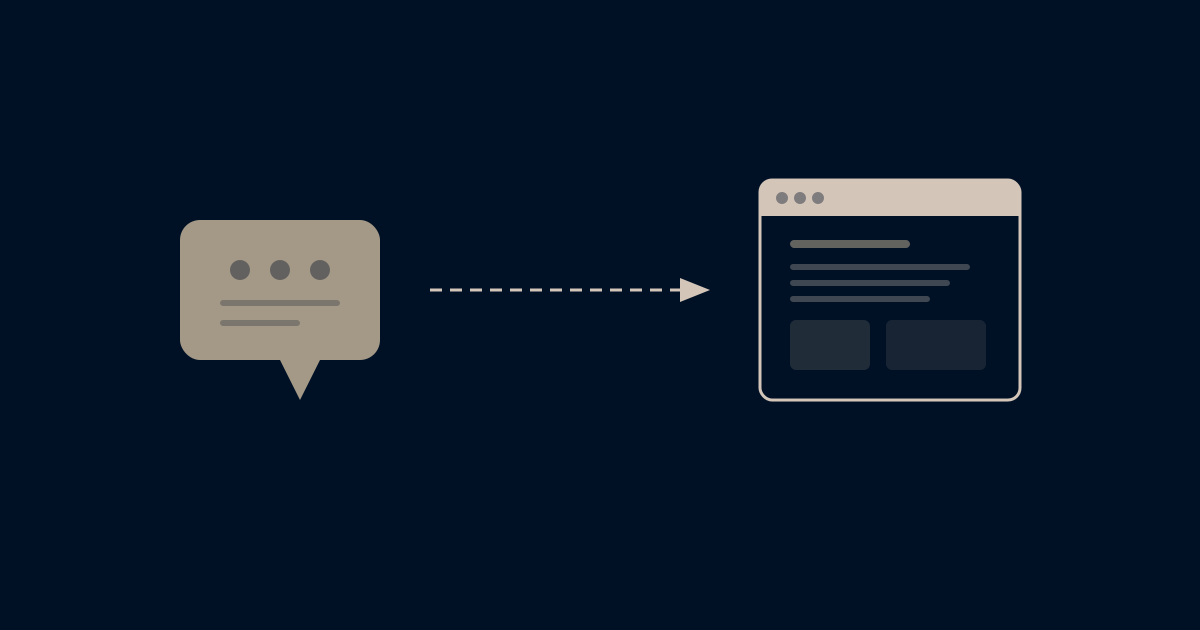
The new way: describe what you want to an AI. It builds the site. You review it. It deploys. The whole process takes minutes, not weeks. No code. No git. No terminal. No developer.
This is not a future promise. This is how Host Direct works today.
The Website Problem No One Talks About
Small business owners do not have a website problem. They have a website maintenance problem.
Getting a site built is straightforward — pay someone, wait, launch. The pain starts after launch. Content updates require a developer or a CMS you barely understand. Security patches pile up. Hosting bills creep from $20 to $50 to $200 a month. The WordPress plugin that handled your contact form breaks after an update, and suddenly leads stop coming in.
According to WordPress.com's own data, 43% of all websites run on WordPress. What that statistic does not mention is how many of those sites are outdated, insecure, or abandoned because the owner could not maintain them without technical help.
The problem is not building a website. The problem is that every website comes with invisible dependencies — hosting, domains, SSL certificates, CMS updates, plugin maintenance, security monitoring — and each dependency is a point of failure that requires technical knowledge to fix.
What if the entire dependency chain disappeared?
What Changed in 2026
Two things converged that make this article possible.
First, AI learned to write production code. Not prototypes. Not demos. Real, deployable websites. Tools like Claude from Anthropic can take a plain-English description — "I need a professional portfolio site with a hero section, three service cards, a testimonials section, and a contact form" — and produce a complete, responsive, well-designed website.
This was not possible two years ago. The code quality was not there. The design sensibility was not there. Today, the output is genuinely good — clean HTML and CSS, mobile-responsive, fast-loading, and modern.
Second, deployment stopped requiring developers. Traditionally, getting a website from "files on your computer" to "live on the internet" required git (a version control system), a terminal (command line), and knowledge of deployment platforms. That entire workflow existed because deployment platforms were built for developers.
Waymaker Host introduced something called Host Direct — a deployment path designed for AI. Instead of pushing code through git, the AI uploads the finished site directly to the hosting platform. No repository. No build pipeline. No terminal commands. The AI handles the deployment the same way it handled the code: automatically.
The result is a complete path from idea to live website that never requires technical skills at any step.
How Host Direct Works (The Non-Technical Version)
Here is the entire process, step by step. If you can have a conversation, you can do this.
Step 1: Open Claude Desktop
Claude Desktop is a free application from Anthropic. Download it, sign in, and you have access to an AI that can write code, create files, and — when connected to Waymaker Host — deploy websites.
The connection between Claude Desktop and Waymaker Host happens through something called MCP (Model Context Protocol). You do not need to understand what that means. You configure it once, and from that point forward Claude can deploy directly to your hosting account.
Step 2: Describe Your Website
This is the part that replaces hiring a developer. Instead of writing a brief, sending it to a freelancer, and waiting for mockups, you describe what you want in plain English.
Example conversation:
"I need a website for my consulting practice. The company is called Meridian Advisory. We help mid-market companies with operational strategy. I want a clean, professional design with a navy and white colour scheme. The site needs a hero section with our tagline 'Strategy that moves', three service cards for Strategic Planning, Operational Excellence, and Growth Advisory, a short About section, three client testimonials, and a contact form. One page, mobile-friendly."
Claude builds the entire site from that description. HTML, CSS, responsive design, the lot. You can see a preview before anything goes live.
Step 3: Review and Refine
Here is where the AI workflow beats the traditional workflow. With a developer, revision cycles take days. Emails back and forth. "Can you make the header bigger?" followed by a 48-hour wait.
With Claude, revisions happen in the same conversation:
"Make the hero section taller. Change the tagline to 'Strategy that delivers.' Add a fourth service card for Digital Transformation. Make the contact form include a phone number field."
Changes appear in seconds. Not hours. Not days. Seconds.
Step 4: Deploy
When you are happy with the site, one sentence does it:
"Deploy this to my Waymaker Host account."
Claude uploads the site directly through Host Direct. No git commands. No terminal. No build process. The site is live on a URL you can share immediately.
Step 5: Add Your Domain
Want it on yourbusiness.com instead of a platform URL? That is a configuration step in Waymaker Host — point your domain, and the platform handles SSL certificates, CDN distribution, and global edge delivery automatically.
Total time from idea to live website: 15-45 minutes. Not days. Not weeks. Minutes.
What You Can Build
Host Direct is designed for the kinds of sites that small businesses, consultants, and solopreneurs actually need. These are the sites people currently overpay for on WordPress, Wix, or Squarespace.
Landing pages. A single page promoting a service, event, or offer. Clear headline, compelling copy, call to action. The kind of page that converts visitors into enquiries.
Portfolio sites. Showcase your work. Consulting projects, design work, photography, case studies. Clean grid layouts, project descriptions, contact information.
Small business sites. The 3-5 page site every local business needs — Home, About, Services, Contact. Hours of operation. Location map. Team photos and bios.
Event pages. Conference landing pages. Workshop registrations. Product launch announcements. Build it the week before, take it down the week after.
Coming soon pages. Email capture, countdown timer, brand statement. Launch it in 10 minutes while the full site is still being planned.
Restaurant and hospitality sites. Menu, hours, location, reservation link. Updated as often as the menu changes — which, with AI, takes 30 seconds instead of a support ticket.
Personal brand sites. Speaker pages, author sites, coach profiles. Bio, testimonials, booking links, media kit.
Every one of these sites is currently being built by developers charging $2,000-10,000, or squeezed into drag-and-drop builders that charge monthly fees for templates.
What You Cannot Build (Yet)
Honesty matters more than hype. Host Direct is not the right tool for everything.
Complex e-commerce. If you need a full online store with shopping cart, inventory management, payment processing, and order fulfilment, you need a dedicated e-commerce platform like Shopify. Host Direct can build a product showcase page with a link to your Shopify store, but it is not replacing Shopify.
Membership sites with payment flows. Gated content, subscription management, user dashboards — these require backend logic and database integration that goes beyond a static site deployment.
Web applications. If what you need is actually software — a booking system, a client portal, a project tracker — that is a different category. WaymakerOS can build those too through custom app development, but it is a different process than Host Direct.
Sites that need a CMS for daily content updates. If you publish blog posts three times a week and need a content management system with drafts, scheduling, and editorial workflows, a static site deployed through AI is not the right fit today.
The honest boundary: Host Direct excels at sites where the content changes occasionally and the structure is straightforward. For most small businesses, that covers 90% of what they need.
The Cost Comparison
This is where the math gets interesting.
WordPress (Self-Hosted)
- Hosting: $10-50/month (basic) or $30-200/month (managed)
- Domain: $12-20/year
- Theme: $0-80 (one-time)
- Essential plugins (security, SEO, forms, backup): $100-400/year
- Developer for initial build: $2,000-10,000
- Developer for ongoing changes: $75-150/hour
- Year one total: $3,000-12,000+
- Annual maintenance: $500-3,000+
- Hidden cost: your time managing updates, security, and plugin conflicts
Wix
- Plan: $17-159/month depending on tier
- Domain: included on some plans
- No developer needed for basic sites
- Limited customisation beyond templates
- Annual cost: $204-1,908
- Hidden cost: design limitations, slow page speeds, difficulty migrating away
Squarespace
- Plan: $16-49/month
- Domain: included first year
- Beautiful templates, limited flexibility
- Annual cost: $192-588
- Hidden cost: you are renting a template, not owning a site
Host Direct on Waymaker Host
- Hosting: included with your licence, with compute metered — see current Host pricing
- Custom domain: included
- Bandwidth: included
- SSL certificate: included (automatic)
- Global edge network (300+ cities): included
- DDoS protection: included (enterprise-grade)
- Developer: $0 (AI builds it)
- Ongoing changes: $0 (ask AI to update it)
Read that list again. A professionally built, globally distributed, enterprise-grade hosted website — with no developer fees, no plugin costs, and no security anxiety.
The infrastructure behind Host Direct runs on a global edge network in 300+ cities worldwide. Your small business site loads as fast as a Fortune 500 company's because it runs on the same infrastructure. That was not accessible to small businesses before.
Who This Is Actually For
Host Direct was not built for developers. Developers already have their workflows — git, CI/CD pipelines, preview deployments. Those workflows are excellent for software teams.
Host Direct was built for everyone else.
The consultant who has been meaning to update their website for six months but cannot justify a $3,000 developer invoice for what amounts to new copy and a fresh design.
The small business owner paying $150/month for managed WordPress hosting and another $100/month for a "website care plan" that mostly means someone else clicks the update buttons.
The solopreneur who built a Wix site three years ago and has been fighting its limitations ever since — slow load times, design constraints, SEO limitations.
The marketing manager who needs a campaign landing page by Friday and does not want to file a ticket with the dev team, wait in the sprint queue, and get it three weeks after the campaign launched.
The franchise operator who needs 12 location pages that look consistent but have different addresses, hours, and team photos — and needs them updated when things change without calling a developer each time.
The event organiser who needs a registration page for next month's conference and will need to take it down afterward. Paying a developer $2,000 for a page that lives for 30 days does not make sense.
These are not edge cases. These are the majority of website needs in the small and mid-market.
The Bigger Picture: AI Changes Who Gets to Build
Five years ago, if you wanted custom software, you needed developers. If you wanted a website, you needed a developer or a template builder. If you wanted changes, you needed to wait in someone else's queue.
That constraint is dissolving. Not slowly. Rapidly.
2026 is the year of custom apps — the year when the cost of building collapsed below the cost of buying generic software. Host Direct is one expression of that shift, applied to the most universal software need: a website.
But the principle extends further. The same AI that builds your website can build a custom client portal, an internal dashboard, or an operations tool. The same platform that hosts your website can host custom applications that connect to your business data through WaymakerOS.
Today, you deploy a landing page. Next month, you build an internal tool for your team. The month after, you deploy an automation that runs while you sleep. The platform grows with you because it was designed as a foundation you operate on and a build layer you extend.
That is a fundamentally different proposition than renting a template from Squarespace.
Common Questions
"Is the AI output actually good enough?"
Yes, with a caveat. AI-generated websites in 2026 are clean, responsive, well-structured, and modern. They are not going to win design awards for experimental typography. They are going to look professional, load fast, and work on every device. For a consulting firm's portfolio or a restaurant's menu page, that is exactly what is needed.
"What if I need changes later?"
Open Claude Desktop, describe the changes, redeploy. The same conversation that built the site can update it. "Add a new testimonial from Sarah Chen at Meridian Corp" takes seconds, not a support ticket.
"Do I own the code?"
Yes. The site deployed to Waymaker Host is your code. You can download it, inspect it, modify it, or move it elsewhere. No lock-in.
"What about SEO?"
AI-built sites can include proper meta tags, structured data, semantic HTML, and fast load times — the foundations of good SEO. Claude can implement these when you ask. "Make sure this site is optimised for the search term 'operational strategy consulting Sydney'" is a valid instruction.
"What about forms and email?"
Contact forms can be built into the site. For form submissions, you can connect to services like Formspree or use Waymaker's own infrastructure. Email delivery is a separate concern from the website itself — but it is a solvable one within the same platform.
"Is this just for simple sites?"
Host Direct is designed for static and near-static sites — the kind that represent 80% of small business website needs. For dynamic web applications with user accounts, databases, and real-time features, WaymakerOS offers a full development platform through Host's app and Ambassador capabilities. Host Direct is the entry point, not the ceiling.
Getting Started
Three things you need:
-
A Waymaker Host account. Sign up at waymakeros.com. The platform includes 20 productivity tools alongside hosting — so you get project management, documents, goals, and more, not just a place to put a website.
-
Claude Desktop. Download from claude.ai/download. Free to use, with paid tiers for heavier usage.
-
An idea for your site. The clearer you describe what you want, the better the result. Spend five minutes writing down your pages, sections, colours, and content before starting the conversation.
That is it. No git to install. No terminal to learn. No deployment pipeline to configure. No developer to hire.
Describe what you want. Review what you get. Deploy when it is ready.
Your website should work for your business, not the other way around.
Ready to build? WaymakerOS gives you the hosting platform and the productivity tools in one place. Describe your site to Claude, deploy through Host Direct, and move on to running your business. Get started with WaymakerOS.
Related reading: Learn why 2026 is the year of custom apps, see how WaymakerOS compares as an all-in-one business platform, explore operations at the edge, or understand the real cost of app sprawl.
Part of our guide to building and hosting what no one will build for you.
About the Author

Waymaker Editorial
Stuart Leo founded Waymaker to solve a problem he kept seeing: businesses losing critical knowledge as they grow. He wrote Resolute to help leaders navigate change, lead with purpose, and build indestructible organizations. When he's not building software, he's enjoying the sand, surf, and open spaces of Australia.