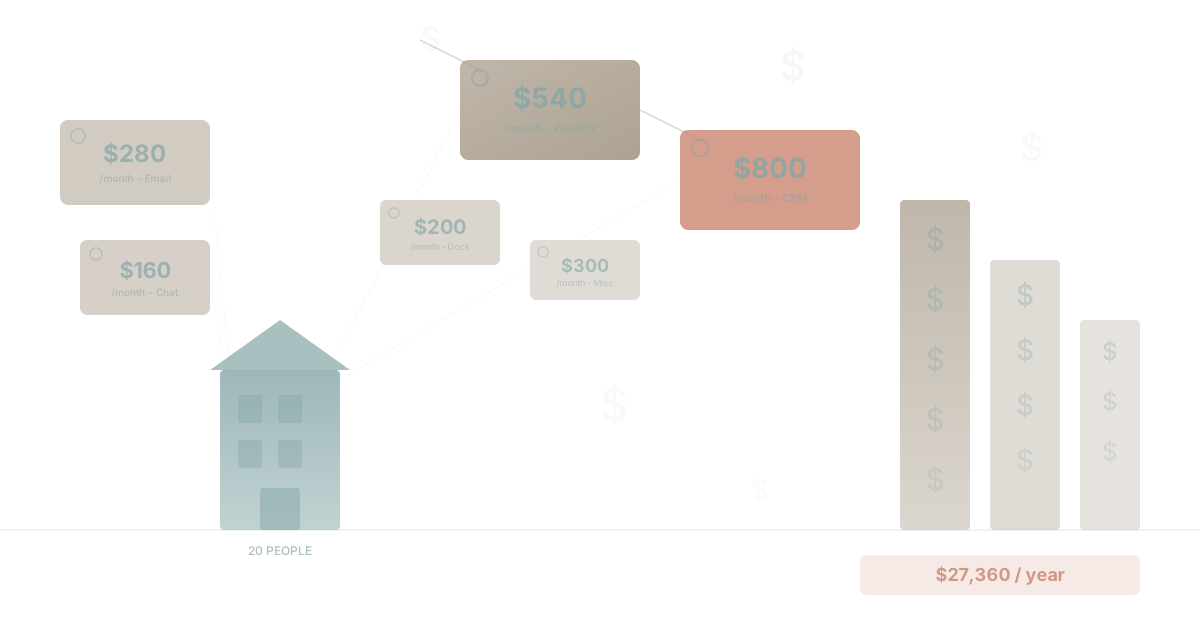
Pat runs a 20-person logistics company in Brisbane. She's been at it for twelve years. The warehouses run tight, the trucks run on time, and the margins are thin enough that she notices every dollar.
So when her bookkeeper pulled the full list of software subscriptions last quarter, Pat did what any owner would do. She added them up.
Monday.com Pro for project management: $540 per month. Google Workspace Business for email and docs: $280 per month. Slack Pro for team communication: $160 per month. HubSpot Professional for CRM and marketing: $800 per month. Notion Team for internal knowledge: $200 per month. Miscellaneous tools — Zoom, Calendly, 1Password, Canva, DocuSign, and a handful of others: $300 per month.
Total: $2,280 per month. $27,360 per year.
Pat stared at the number for a long time. That's a full-time salary. For software that doesn't even talk to itself.
The Number Nobody Budgets For
Pat's situation isn't unusual. It's the norm.
According to Gartner's 2025 IT spending forecasts, small and mid-size businesses spend a disproportionately large share of revenue on software compared to enterprises. The U.S. Small Business Administration reports that businesses with fewer than 50 employees represent 97% of all employer firms — and collectively, they're the largest purchasers of per-seat SaaS subscriptions in the market.
The breakdown Pat found isn't an anomaly. It's a pattern that plays out in nearly every small company that's adopted cloud software over the past decade. The app sprawl crisis didn't happen overnight. It happened one subscription at a time, each one solving a real problem, each one adding another line to the credit card statement.
Here's what $27,360 per year looks like when you lay it out:
| Tool | Purpose | Monthly Cost | Annual Cost |
|---|---|---|---|
| Monday.com Pro | Project management | $540 | $6,480 |
| Google Workspace | Email, docs, calendar | $280 | $3,360 |
| Slack Pro | Team communication | $160 | $1,920 |
| HubSpot Professional | CRM & marketing | $800 | $9,600 |
| Notion Team | Knowledge base | $200 | $2,400 |
| Misc. (Zoom, Calendly, etc.) | Various | $300 | $3,600 |
| Total | $2,280 | $27,360 |
And this is before you count the costs that don't appear on invoices — the context switching, the duplicate data entry, the integration maintenance, the unused licenses. Those hidden costs add another $2,400 per employee per year, pushing the real number well past $70,000 for a 20-person team.
The Enterprise Irony
Here's what makes Pat's $27,360 so frustrating: a company with 2,000 employees running the same tools pays less per person than she does.
Enterprise buyers negotiate volume discounts of 30-60% off list price. They get dedicated account managers who pick up the phone. They get custom integrations built into their contracts. They get flexible billing terms, free onboarding, and priority support.
According to McKinsey's research on enterprise software procurement, large organisations routinely negotiate SaaS contracts that cut per-seat costs by 40% or more. A company with 500 seats on Monday.com isn't paying $27 per seat. They're paying $14-16 after negotiation — and getting a dedicated success team thrown in.
Pat pays the full sticker price. Per seat. No negotiation. No dedicated support. Self-serve onboarding. Community forums instead of phone lines.
The per-seat pricing model was designed for enterprises. It scales beautifully when you have procurement teams, legal departments, and the leverage that comes with a 500-seat purchase order. When applied to a 20-person company, the same model becomes a tax on being small.
What Enterprises Get vs. What SMBs Get
| Enterprise (500+ seats) | Small Business (5-50 seats) | |
|---|---|---|
| Pricing | 30-60% volume discount | Full list price |
| Account Management | Dedicated account manager | Self-serve portal |
| Support | Priority phone/video support | Community forums, chatbots |
| Onboarding | Guided implementation team | DIY documentation |
| Integrations | Custom builds in contract | Pay for add-ons separately |
| Billing | Flexible, net-60 terms | Annual lock-in, prepaid |
| Contract Negotiation | Multi-round, custom terms | Take it or leave it |
| Exit | Negotiated transition support | Data export and goodbye |
The irony is that small businesses are the ones who can least afford to overpay — and they're the ones who consistently do.
Per-Seat Pricing Was Never Designed for You
The per-seat model emerged in the enterprise software era. Harvard Business Review has documented extensively how SaaS pricing evolved from perpetual licenses to subscription models in the 2000s, and per-seat pricing became the default because it aligned vendor revenue with customer growth. More employees meant more seats, which meant more revenue. Predictable. Simple. Fair — if you're an enterprise.
But per-seat pricing creates three structural problems for small businesses.
Problem 1: You Pay Full Price for Partial Use
In a 20-person company, not everyone uses every tool. Pat's warehouse team doesn't need HubSpot. Her sales team doesn't need Monday.com's advanced automations. But per-seat pricing on most plans requires either buying seats for everyone or maintaining separate plans with separate admin overhead.
The result is that 25-30% of SaaS licenses go unused in any given period, according to Gartner. For Pat, that's roughly $6,800 per year paying for seats nobody sits in.
The annual software audit checklist exists precisely because this waste accumulates silently. Nobody notices a $14 per seat charge for someone who logged in once three months ago. Multiply that by six tools and ten underused seats, and you've found the budget for a new hire.
Problem 2: Costs Multiply Horizontally
Each tool solves one problem. Email is separate from project management, which is separate from CRM, which is separate from documentation. That's six to ten subscriptions for capabilities that, from a business perspective, all serve the same goal: getting work done.
The per-seat model charges you at every layer. Twenty people times six tools at $10-40 per seat per tool adds up fast. You're not paying for twenty people to use software — you're paying for 120 seat-tool combinations.
This is the horizontal cost multiplication that makes tool sprawl so expensive for small teams. Each new app doesn't just add its subscription. It adds its seat count multiplied by its per-seat price, plus integration cost with every other tool it needs to talk to.
Problem 3: You Can't Negotiate
Enterprise procurement teams negotiate because they can. A 500-seat deal is worth $150,000+ annually to a vendor. That deal gets a sales director's attention, a custom proposal, and room to negotiate.
A 20-seat deal is worth $5,000-10,000. It's a self-serve sign-up. The pricing page is the proposal. "Contact Sales" exists, but calling it for a 20-seat deal usually gets you a polite explanation that the published pricing is the pricing.
The SBA's Office of Advocacy has repeatedly highlighted this structural disadvantage. Small businesses lack the purchasing power to negotiate the terms that larger competitors take for granted.
The Disconnection Premium
Pat isn't just overpaying for individual tools. She's paying a premium for the privilege of having them not work together.
Her customer data lives in HubSpot. Her project timelines live in Monday.com. Her team conversations live in Slack. Her documentation lives in Notion. Her files live in Google Drive.
When a customer calls about a delayed shipment, someone has to check HubSpot for the account history, Monday.com for the project status, Slack for the last team discussion about it, and Google Drive for the shipping manifest. That's four apps and fifteen minutes for a question that should take thirty seconds.
This is context switching at its most expensive. Not just the time lost toggling between apps, but the cognitive load of remembering which system holds which piece of information. McKinsey research shows that knowledge workers spend nearly 20% of their week just searching for information — much of it fragmented across disconnected tools.
Pat pays $27,360 per year for seven disconnected tools. Then she pays again in lost productivity because those tools don't share data. Then she pays a third time in Zapier subscriptions and manual workarounds trying to bridge the gaps.
The disconnection premium is real, and it hits small businesses hardest because they don't have IT departments to build integrations. They don't have data teams to create unified dashboards. They have Pat, her bookkeeper, and twenty people trying to get work done.
The Hidden Costs Behind the Invoice
The $27,360 is just the direct subscription cost. The true cost of running disconnected business software includes layers that never show up on any invoice.
Context switching: Every app switch costs 23 minutes of refocused attention, according to research from the University of California, Irvine. At 10 meaningful switches per day across 20 employees, the conservative productivity loss is $10,400 per year.
Integration maintenance: Zapier plans, API connections, manual data re-entry — someone has to make these apps talk to each other. For a 20-person company, that's roughly $5,600 per year in tools and labour.
Unused licenses: That 25-30% waste rate translates to $6,800 per year for Pat's team. Seats paid for, never used.
Training and onboarding: Every new hire needs to learn six to ten tools. Every tool update requires retraining. The time cost compounds every quarter.
Security and compliance: Each tool is a separate attack surface, a separate password, a separate set of permissions to manage. Without IT staff, this falls to whoever can figure it out.
| Cost Category | Annual Cost |
|---|---|
| Direct subscriptions | $27,360 |
| Context switching loss | $10,400 |
| Integration maintenance | $5,600 |
| Unused licenses | $6,800 |
| Training overhead | $3,200 |
| True annual cost | $53,360 |
Over fifty thousand dollars. For a 20-person company. To run software that was priced for enterprises and sold to everyone else without modification.
What the Alternative Looks Like
The answer isn't to stop using software. It's to stop paying enterprise prices for a disconnected experience that enterprises themselves would never accept.
A unified productivity platform changes the math by collapsing multiple point solutions into a single system. Instead of paying per seat across six separate tools, you pay one price that includes project management, CRM capabilities, documentation, goal tracking, meeting management, and team communication — all sharing the same data layer.
The financial impact of consolidating your tech stack is straightforward:
Direct cost reduction of 40-60%: One subscription replaces five to eight. Seat costs drop because you're not multiplying seats across multiple tools.
Indirect cost reduction of 60-70%: Context switching drops dramatically when everything lives in one system. Integration maintenance drops to near zero because there's nothing to integrate. Data lives in one place, so nobody spends 20% of their week hunting for information.
Hidden cost reduction of 50-60%: Fewer tools means fewer unused licences to track. Shadow IT becomes less tempting when the official platform covers what people actually need.
For a company like Pat's, consolidation could look like this:
| Category | Before (Disconnected) | After (Unified) |
|---|---|---|
| Direct subscriptions | $27,360/yr | $9,120/yr |
| Productivity losses | $16,000/yr | $5,000/yr |
| Hidden costs | $10,000/yr | $3,000/yr |
| Total | $53,360/yr | $17,120/yr |
| Annual savings | $36,240 |
That's $36,240 back in the budget. Enough for a part-time hire. Enough to invest in the business instead of subsidising six different software companies.
The Pricing Model Small Businesses Deserve
Per-seat pricing across disconnected tools is a model that benefits vendors, not customers. It was designed for enterprises with procurement leverage and applied unchanged to businesses with none.
Small businesses deserve a different model. One where the platform includes the tools you need at one price point. One where adding a capability doesn't mean adding another subscription. One where your data lives in a single system so you're not paying three times — once for the tool, once for the integration, and once in lost productivity.
The Monday.com pricing structure makes sense if you only need project management. The ClickUp pricing model makes sense if you only need task management. The Notion pricing tiers make sense if you only need documentation.
But nobody needs just one thing. Every business needs all of these capabilities working together. And the moment you need more than one tool, per-seat pricing across disconnected platforms stops being a pricing model and starts being a structural tax on small businesses.
Pat's Decision
Pat didn't cancel all her subscriptions the next morning. She's too practical for that.
But she did something she'd never done before. She pulled every software invoice from the past twelve months, sorted them by vendor, and built a spreadsheet. She tagged each tool by how many people actually use it, how often, and whether it could be replaced by a platform that bundles the capability.
The spreadsheet told her what she already suspected: she was paying enterprise prices for a small business experience. No volume discounts. No dedicated support. No integrations included. Just invoices.
She started with the question that matters: What would it look like to build her operations on one platform instead of stitching together seven?
The answer surprised her. Not because the platform was cheaper — though it was. But because the real savings weren't in the subscription line. They were in the hours her team would get back. The searches they wouldn't have to make. The data they wouldn't have to re-enter. The integrations they wouldn't have to maintain.
Twenty people, working in one system, paying one price.
That's not a radical idea. It's what enterprise buyers have demanded for decades. It's just that nobody bothered to offer it to the other 97% of businesses until now.
About the Author

Stuart Leo
Stuart Leo founded Waymaker to solve a problem he kept seeing: businesses losing critical knowledge as they grow. He wrote Resolute to help leaders navigate change, lead with purpose, and build indestructible organizations. When he's not building software, he's enjoying the sand, surf, and open spaces of Australia.