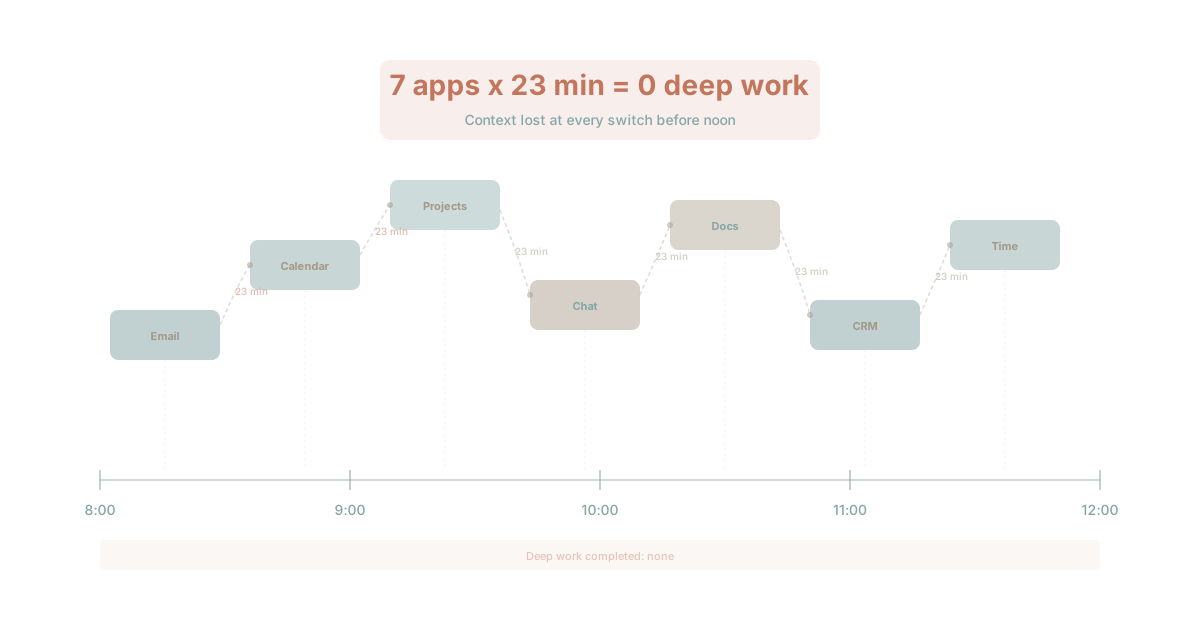
It is 8:47 AM on a Tuesday. You have not done any real work yet.
You opened Gmail to triage your inbox. A client email sent you to HubSpot to check the deal status. That reminded you to update the project timeline in Monday.com. A notification pulled you into Slack, where someone asked about a document you had drafted in Google Docs. You checked your Google Calendar to confirm a meeting time. Then you opened Harvest to log the 45 minutes you just spent doing... what, exactly?
Seven apps. Zero deep work. And it is not even noon.
This is not a productivity failure. This is a systems failure. And it is costing your business far more than you think.
The Morning App Gauntlet
Walk through the first four hours of a typical knowledge worker's day. Not a chaotic day. Not a crisis. Just a normal Tuesday.
8:00 AM -- Gmail. Scan inbox. Respond to two client messages. Flag three internal threads for follow-up. Notice a calendar invite that needs a response.
8:25 AM -- Google Calendar. Accept the meeting. Realize you need to prepare a status update. The project data is in Monday.com.
8:35 AM -- Monday.com (or Asana, or ClickUp). Pull up the project board. Update three task statuses. Notice a comment from yesterday you missed. Respond. A teammate mentions a Slack thread.
8:55 AM -- Slack. Read the thread. It references a Google Doc. You need to review the latest version before the 10 AM meeting.
9:10 AM -- Google Docs. Open the document. Make edits. Leave comments. Realize you need data from the CRM to finish a section.
9:30 AM -- HubSpot (or Salesforce, or Pipedrive). Pull the customer data. Export it. Paste it into the document. Notice the deal stage needs updating based on yesterday's call.
9:50 AM -- Harvest (or Toggl, or Clockify). Log the time you have spent across these tasks. Try to remember which project each activity belongs to. Guess.
It is 10:00 AM. You have a meeting. You have touched seven applications. You have completed zero items of deep, focused work.
This is not an exaggeration. Research shows knowledge workers switch applications hundreds of times per day. The morning gauntlet is not the exception. It is the standard operating procedure for modern work.
The 23-Minute Tax on Every Switch
Here is where the cost compounds.
Gloria Mark, a professor of informatics at the University of California, Irvine, has spent over two decades studying attention and distraction in the workplace. Her research, published across peer-reviewed journals and summarized in her book Attention Span, found that after an interruption or task switch, it takes an average of 23 minutes and 15 seconds to fully return to the original task.
Not 23 seconds. Twenty-three minutes.
And the problem is worse than a single number suggests. Mark's research also found that people do not return directly to the interrupted task. On average, they visit 2.26 other tasks before coming back to the original. The switch creates a cascade, each interruption spawning additional detours.
Cal Newport calls this the "attention residue" problem in Deep Work. When you shift from Task A to Task B, part of your cognitive attention remains stuck on Task A. You are physically looking at Task B, but mentally still processing Task A. This residue degrades the quality of your work on Task B and makes it harder to reach full engagement with anything.
The morning app gauntlet from our example above contains at least 10 meaningful context switches. Apply the research.
10 switches x 23 minutes = 230 minutes of fragmented recovery time.
That is nearly four hours. Before lunch.
Not all switches trigger a full 23-minute recovery. A quick calendar check might cost only 30 seconds. But the deep switches -- moving from writing a document to analyzing CRM data to responding in a threaded conversation -- carry the full cognitive penalty. Even conservatively, the morning gauntlet costs 90 to 120 minutes of productive capacity. Every single day.
The Math Your Team Cannot Afford
Scale the individual cost across a team and the numbers become alarming.
Per Employee
- Conservative estimate: 2 hours lost daily to context switching friction
- At $50/hour fully loaded cost: $100/day per employee
- Annually (250 working days): $25,000 per employee per year
For a 20-Person Team
- Daily: 40 hours of collective productivity lost
- Weekly: 200 hours -- the equivalent of 5 full-time employees doing nothing
- Annually: $500,000 in invisible productivity drain
For a 100-Person Company
- Weekly: 1,000 hours lost
- Annually: $2.5 million evaporating into the friction between applications
These numbers align with broader research. McKinsey estimates that knowledge workers spend 28% of their workweek managing email alone. Harvard Business Review reports that workers toggle between apps and websites roughly 1,200 times per day, with the cumulative switching cost consuming up to 4 hours daily.
The subscription fees for those seven apps might total $200 per user per month. The real cost of app sprawl is the $2,000 per user per month in lost productivity hiding behind them.
Why Seven Apps Is Actually a Low Number
If you thought seven apps before lunch sounded like a lot, the reality is worse. Gartner research finds the average mid-market company uses over 130 SaaS applications. Even small businesses with 10 to 50 employees typically maintain 25 to 50 active subscriptions.
The 47-app problem is not theoretical. It is the statistical norm. Seven apps before noon is restraint.
And each app brings its own notification system, its own interface conventions, its own mobile app demanding attention. The aggregate effect is what researchers call attention fragmentation -- the systematic destruction of the sustained focus required for meaningful work.
This is not just a productivity problem. It is an organizational memory problem. When information is scattered across seven apps, nobody holds the complete picture. Customer context lives in the CRM. Project status lives in the project tool. Decision rationale lives in Slack threads that scroll past and disappear. The organization develops amnesia because its memory is fractured across systems that do not communicate. And when you try to layer AI on top of fragmented data, the problem compounds further -- effective AI requires unified context, not scattered inputs.
The Deep Work Deficit
Cal Newport defines deep work as "professional activities performed in a state of distraction-free concentration that push your cognitive capabilities to their limit." This is the work that creates value: strategic thinking, creative problem-solving, complex analysis, meaningful writing.
Deep work requires sustained attention -- typically 60 to 90 minutes of uninterrupted focus. But if your team is switching apps every 40 seconds (the RescueTime average), uninterrupted focus does not exist. The morning app gauntlet ensures that by the time deep work could begin, the day is already fractured.
The cost is not just time. It is quality. Work produced during fragmented attention is measurably worse than work produced during sustained focus. Decisions are shallower. Analysis is less thorough. Writing is less precise. Strategy is less creative.
Your team is not lazy. Your team is not unfocused. Your team is trapped in a system designed to prevent focus. The seven-app morning is not a personal discipline problem. It is an infrastructure problem.
The Consolidation Arithmetic
What would it look like to reduce seven apps to one or two?
Consider what happens when email, calendar, project management, documents, CRM, and time tracking share a single platform with a unified interface.
Switch elimination: Instead of 10 context switches before noon, you make 2 or 3. The project board and the document and the customer data exist in the same workspace. No export-paste-import cycle. No hunting through tabs.
Context preservation: When you move from checking a task to editing a document, the platform retains context. You do not need to mentally reload "which project was this for" or "what was the customer's situation." The system knows.
Notification consolidation: Instead of seven separate notification streams competing for attention, one intelligent stream that understands priority and relevance.
The consolidation math is straightforward. If context switching costs your 20-person team $500,000 annually, and consolidation reduces switching by even 50%, you recover $250,000 in productive capacity. That dwarfs the cost of any platform subscription.
A CIO planning tool rationalization will show the same conclusion from a governance perspective. Fewer tools mean fewer security surfaces, fewer vendor relationships, fewer integration failure points, and fewer training requirements for new employees.
The Audit You Should Run Today
Before you can fix the problem, you need to measure it. Here is a practical exercise for your team.
Step 1: Track the morning gauntlet. For one week, ask every team member to log which apps they use before noon and how many times they switch. Do not change behavior -- just observe.
Step 2: Count the switches. Total the number of meaningful context switches (not quick glances, but actual task transitions requiring cognitive loading).
Step 3: Apply the formula. Multiply meaningful switches by your conservative cost estimate. Even at 5 minutes per switch (far below the 23-minute research finding), the numbers will be significant.
Step 4: Map the overlaps. Identify which apps serve similar functions. Where do you have three tools that could be one? Where is information duplicated across systems? Use an annual software audit checklist as your guide.
Step 5: Calculate the real total cost of ownership. Subscription fees plus switching costs plus integration maintenance plus training overhead plus security governance. The visible cost is typically less than 20% of the true cost.
What Unified Work Actually Feels Like
Imagine the same Tuesday morning, rebuilt.
8:00 AM. Open your workspace. Your inbox, tasks, and calendar are in a single view. Triage email without leaving the platform. A client message links directly to their project context -- no app switch needed.
8:20 AM. Move to the project board. Task updates, document edits, and team comments exist in the same environment. The document you need to review is one click away, not an app switch away.
8:40 AM. Review customer data alongside project notes. No export. No paste. The data and the context coexist.
9:00 AM. You have been working for one hour. You have completed actual work. You are ready for deep focus on the strategic analysis that requires sustained attention.
This is what the unified productivity model looks like in practice. Not fewer features -- the same capabilities, without the switching tax.
The technology exists to build apps that bring these fragmented workflows together. The question is not whether consolidation is possible. It is whether you can afford to keep paying the switching tax while you wait.
The Compounding Cost of Inaction
Every day you do not address the seven-app morning is another day of compounding loss. Context switching costs do not plateau. They increase as teams grow, as tool counts expand, and as work complexity rises.
HBR research confirms the trend is accelerating. The average number of apps per company has grown 30% in three years. Remote and hybrid work have added communication tools on top of existing stacks. AI assistants are adding yet another layer of tools demanding attention.
The organizations that solve this problem will have a structural advantage. Their people will do more meaningful work in less time. Their institutional memory will be richer because it is not fragmented across dozens of silos. Their strategic decisions will be better because they are based on unified context rather than partial views stitched together from multiple systems.
The seven-app morning is not inevitable. It is a design choice -- and it can be redesigned.
Start With One Morning
You do not have to overhaul your entire tool stack tomorrow. Start with one morning. Track the switches. Count the cost. Share the numbers with your team.
The gap between what your team could accomplish with sustained focus and what they actually accomplish through fragmented switching is the most expensive line item that never appears on a budget.
Waymaker Commander brings projects, tasks, documents, goals, and team collaboration into one workspace -- so your mornings start with work, not with app switching.
Stuart Leo is the founder of Waymaker and author of Resolute. He has helped over 500 organizations identify and eliminate the hidden costs of tool fragmentation.
About the Author

Stuart Leo
Stuart Leo founded Waymaker to solve a problem he kept seeing: businesses losing critical knowledge as they grow. He wrote Resolute to help leaders navigate change, lead with purpose, and build indestructible organizations. When he's not building software, he's enjoying the sand, surf, and open spaces of Australia.