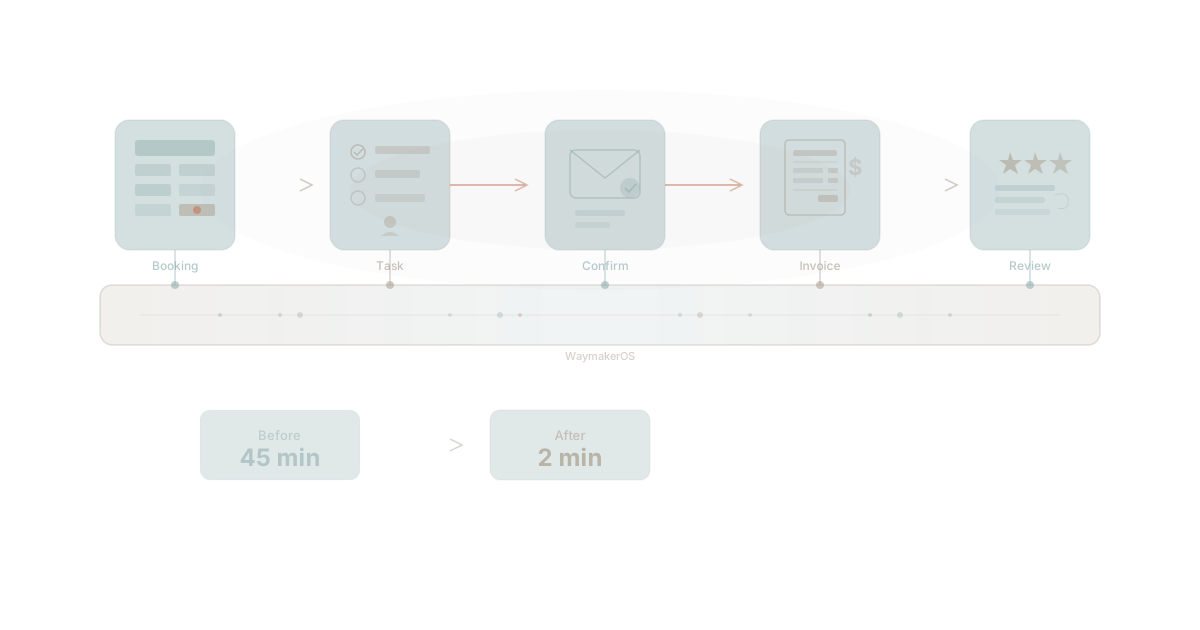
A guest in London books a sunset kayak tour on a Tuesday afternoon. Within two minutes, the guide is assigned, the confirmation email is sent, the invoice is generated, and a review request is scheduled for two days after the tour. Nobody copies a name into a spreadsheet. Nobody pastes a dollar amount into accounting software. Nobody remembers to send the follow-up.
Six months ago, that same booking triggered 45 minutes of manual work across four different systems.
This is the story of how a 15-person adventure tour operator in coastal Australia rewired booking-to-invoice into a single automated flow and reclaimed thousands of hours per year.
The Before: Eight Tools, One Booking, 45 Minutes
The operator -- we will call them Coastal Adventures -- runs guided ocean kayaking, snorkelling, and hiking tours for domestic and international visitors. Fifteen staff including guides, an operations manager, a bookkeeper, and a small front-office team.
Their tech stack before the change looked like every other tourism business. Eight core tools, none of which talked to each other.
1. Booking platform (Rezdy) -- the system of record for tour availability, pricing, and guest reservations. The source of truth for what was sold and when.
2. Channel manager (Rezdy Channel Manager) -- distributing availability across Viator, GetYourGuide, and their direct website. Connected to the booking platform but isolated from everything downstream.
3. Email (Gmail via Google Workspace) -- confirmation emails to guests, internal coordination, supplier communication. Manual for every booking.
4. Accounting software (Xero) -- invoicing, revenue tracking, BAS reporting. Booking data arrived here via a weekly manual reconciliation ritual.
5. Team chat (WhatsApp groups) -- guide assignments, schedule changes, weather updates. Operational decisions buried in scrolling chat history.
6. Document storage (Google Drive) -- safety briefings, insurance certificates, training manuals. A filing cabinet nobody could navigate under pressure.
7. Review management (manual TripAdvisor and Google monitoring) -- the owner checked review platforms every few days and responded when she remembered. No connection between reviews and specific tours or guides.
8. Payment processing (Stripe via Rezdy) -- transaction data that lived separately from accounting, creating a reconciliation gap every month.
This is the app sprawl crisis in miniature. Eight tools, eight logins, zero integration.
What Happened When a Booking Came In
Every new booking triggered the same painful sequence.
Step 1: Check the booking (2 minutes). Open Rezdy, review the new reservation -- guest name, tour date, group size, dietary requirements, pickup location.
Step 2: Assign a guide (5-10 minutes). Open WhatsApp, check which guide was available, send a message, wait for confirmation. If the first guide was unavailable, repeat. If it was a speciality tour like a night kayak, cross-reference the guide qualification spreadsheet in Google Drive.
Step 3: Send the confirmation email (5-8 minutes). Open Gmail, find the confirmation template in drafts, copy the guest name, tour date, pickup time, and meeting point from Rezdy, paste into the email, personalise with dietary acknowledgment and weather notes, send. For group bookings, repeat for each contact.
Step 4: Create the invoice (8-12 minutes). Open Xero, create a new invoice, manually enter the guest name, tour name, date, amount, and GST calculation. Cross-check against the Rezdy booking to ensure the numbers matched. For agent bookings through Viator or GetYourGuide, calculate the commission split manually.
Step 5: Schedule the review request (3-5 minutes). Add a reminder in Google Calendar to send a review request email two days after the tour. Open the review request template, pre-fill what you can. Hope you remember to actually send it.
Step 6: Update the tracking spreadsheet (5-8 minutes). Open the Google Sheet that served as the operational dashboard. Log the booking date, guest name, tour type, revenue, guide assigned, and payment status. This was the only place where all the data existed in one row -- and it was manually maintained.
Total elapsed time: 28 to 45 minutes per booking. For a business processing 15 to 25 bookings per day during peak season, that was 7 to 18 hours of pure administrative work daily. The equivalent of two full-time employees doing nothing but moving data between systems.
The operations manager, a capable and energetic person, spent her mornings on this admin instead of improving tour quality, training guides, or responding to the guest standing at the counter.
According to McKinsey's research on travel and logistics operations, tourism businesses with fragmented technology stacks spend 25 to 35 percent of operational labour on administrative data transfer. Coastal Adventures was right in the middle of that range.
The Breaking Point
Two things broke in the same week.
First, a guest arrived for a sunset kayak tour that had been rescheduled to the morning due to weather. The guide knew. The guest did not. The confirmation email had been sent before the change, and nobody updated it because the rebooking happened in WhatsApp and the email lived in Gmail. The guest drove 90 minutes for a tour that had already departed.
Second, the bookkeeper discovered that three weeks of Viator commission calculations were wrong. The manual formula in the Google Sheet used the old commission rate. Nobody had updated it when the Viator contract changed. The error meant $2,800 in revenue was incorrectly reported, triggering a painful reconciliation with the accountant.
Neither error was caused by incompetence. Both were caused by disconnected systems requiring perfect human attention across multiple platforms simultaneously. The knowledge silos had finally created visible damage.
The owner sat down on a Friday afternoon and calculated what the fragmentation was actually costing. Using the framework from 12 Apps Run Your Tourism Business, the total came to over $140,000 annually in subscription fees, labour waste, error costs, and lost productivity.
That number changed the conversation from "we should probably fix this someday" to "we are fixing this now."
The Solution: One Platform, One Flow
Coastal Adventures moved to WaymakerOS as their operational layer. Not as a replacement for their booking platform -- Rezdy remained the system of record for tours and availability, because building custom apps does not mean replacing every specialised tool. It means connecting them through a platform that eliminates the manual work between them.
The implementation had two layers.
Layer 1: Commander as the Operational Foundation
Commander replaced four of the eight tools immediately.
Tasks replaced WhatsApp for guide assignments. When a booking created a task, it was assigned to the right guide based on availability and qualifications. The guide saw it in their task list, not buried in a chat thread. The operations manager could see every assignment in one view instead of scrolling through message history.
Docs replaced the scattered Google Drive. Safety briefings, SOPs, training materials, and insurance certificates moved into Commander's document system. When a new guide was onboarded, everything they needed was in one searchable location instead of spread across 47 Drive folders.
Goals replaced the tracking spreadsheet. Revenue targets, booking volumes, and customer satisfaction scores became measurable goals with real-time progress tracking. The Google Sheet that took 5 to 8 minutes per booking to update was gone.
Team coordination replaced WhatsApp groups. Operational decisions were attached to tasks and projects, not lost in chat threads. When someone needed to know why a tour was rescheduled, the context was on the task, not somewhere in a three-day-old WhatsApp conversation.
This first layer delivered immediate value. The team had a unified productivity platform for their daily operations. But the real transformation came from the second layer.
Layer 2: A Custom Booking-to-Invoice App on Host
This is where the build vs buy question resolved itself. No off-the-shelf tool could automate Coastal Adventures' specific booking-to-invoice flow because every operator's flow is slightly different. Commission structures, guide assignment rules, confirmation email content, review timing -- these are unique to each business.
Using WaymakerOS Host, Coastal Adventures built a custom app purpose-designed for their workflow. Built in an IDE with AI assistance -- not dragged and dropped in a limited no-code builder -- and deployed directly to the platform.
The app connects to Rezdy's API via a webhook. When a new booking arrives, the automation executes in sequence.
Booking data flows in. Guest name, tour type, date, group size, dietary requirements, pickup location, payment amount, booking source (direct, Viator, GetYourGuide), and commission rate.
A task is created in Commander. The task includes all booking details, is assigned to the appropriate guide based on a qualification and availability matrix, and has a due date matching the tour date. The guide gets notified immediately.
A confirmation email is sent. The app generates a personalised confirmation using the booking data -- guest name, tour details, meeting point, what to bring, dietary acknowledgment. It sends via the platform's email integration. If the tour is rescheduled later, the app detects the change and sends an updated confirmation automatically.
An invoice is generated. The app calculates the correct amount, applies GST, handles commission splits for agent bookings (using the current contract rates, not a static spreadsheet formula), and creates the invoice in Xero via API. Revenue is categorised by tour type, booking source, and month.
A review request is scheduled. Two days after the tour date, the app automatically sends a personalised review request email with direct links to TripAdvisor and Google Reviews. The request includes the specific tour name and guide, so the guest knows exactly what to review.
The data is connected. When a review comes in, the app matches it to the original booking. The operations manager can see which tours and guides generate the best reviews. This feedback loop -- invisible when reviews lived in a separate silo -- became one of the most valuable operational insights the business had ever accessed.
This is what context engineering looks like in practice. The app does not just automate steps. It connects context across the entire booking lifecycle, from the moment a guest clicks "Book Now" to the moment they leave a five-star review.
The After: 2 Minutes, Zero Manual Steps
The same booking that took 45 minutes now takes 2 minutes of human attention. The operations manager glances at the task board each morning, confirms the guide assignments look correct, and moves on to work that actually matters -- tour quality, guest experience, guide training, and business development.
The numbers tell the story.
| Metric | Before | After |
|---|---|---|
| Time per booking (admin) | 28-45 minutes | 2 minutes |
| Daily admin hours (peak season) | 7-18 hours | 0.5-1 hour |
| Invoice errors per month | 4-6 | 0 |
| Confirmation email errors | 2-3 per month | 0 |
| Review request send rate | ~40% (forgotten) | 100% |
| Guide assignment time | 5-10 minutes | Automatic |
| Monthly reconciliation time | 8 hours | 20 minutes |
| Tools requiring daily login | 8 | 2 (Rezdy + Commander) |
The review request improvement alone had a measurable business impact. When every guest receives a timely, personalised review request, the response rate increased from roughly 8 percent to 22 percent. More reviews meant better search ranking on TripAdvisor and Google, which meant more direct bookings, which meant lower commission costs. Skift research consistently shows that review volume and recency are among the strongest drivers of booking conversion in the experience sector.
The invoice accuracy improvement eliminated the monthly reconciliation nightmare. The bookkeeper went from spending two full days per month reconciling Rezdy, Xero, and the tracking spreadsheet to a 20-minute spot check. According to Gartner's analysis of operational efficiency, eliminating manual data transfer between financial systems reduces error rates by 85 to 95 percent on average.
What This Cost
Transparency matters, so here are the real numbers.
WaymakerOS subscription: The team of 15 on the platform for Commander, Host, and the custom app.
Custom app development time: The booking-to-invoice app took approximately two weeks to build using AI-assisted development in an IDE. No outside developer was hired. The owner, who had no prior coding experience, built it with Claude Code in their IDE, describing what the app should do and iterating on the result. This is the 2026 reality of custom app development -- you do not need a software team.
Integration work: Connecting to Rezdy's webhook API and Xero's invoicing API required configuration, not custom middleware. The platform handled authentication and data routing.
Total cost in the first year: Substantially less than the $140,000 annual cost of the fragmented system it replaced. The ROI was not close. It was overwhelming.
The comparison is not even WaymakerOS versus the old stack. The comparison is WaymakerOS versus continuing to pay two full-time-equivalent salaries for humans to be the integration layer between eight disconnected tools.
The Lessons That Transfer
Coastal Adventures is a composite drawn from real tourism operations. The details are specific to tour operators, but the pattern is universal. Every service business has a version of this story.
Lesson 1: The Booking System Stays
Nobody replaced Rezdy. Specialised booking platforms do their core job well. The problem was never the booking system. The problem was everything that happened after the booking -- the manual steps between booking and fulfilment, between fulfilment and accounting, between accounting and insights.
A platform approach does not mean replacing every tool. It means consolidating the operational layer so data flows without human intervention.
Lesson 2: The Custom Part Is Small but Critical
The booking-to-invoice app is not a large application. It is a focused automation that handles one specific workflow. But that one workflow consumed more labour than any other process in the business. Identifying the highest-cost manual workflow and automating it first delivers disproportionate returns.
Lesson 3: Reviews Need Connection, Not Just Collection
The unexpected win was connecting reviews to specific tours, guides, and booking sources. When review data is isolated in TripAdvisor, it is feedback. When review data is connected to operational data, it is intelligence. The operations manager discovered that one particular guide consistently generated five-star reviews on sunset tours but average reviews on morning tours. A simple schedule adjustment -- assign that guide to sunset shifts -- improved the overall review score measurably.
Lesson 4: Automation Compounds
The initial app handled booking-to-invoice. Within a month, the team extended it. Weather-triggered tour rescheduling with automatic guest notification. Guide availability that updates based on leave requests in Commander. Seasonal pricing adjustments that flow from a single configuration change to every downstream system.
Each addition was small. The compound effect was transformational. This is the flywheel that Harvard Business Review research on operational automation describes: once the first workflow is automated on a connected platform, subsequent automations are dramatically faster because the data layer already exists.
Lesson 5: The Person Closest to the Problem Should Build the Solution
The owner built the app, not a developer. She understood the nuances of guide assignment -- which certifications matter for night tours, which guides prefer morning shifts, how commission structures differ between Viator and GetYourGuide. A developer would have needed weeks of requirements gathering to capture what she already knew.
This is the build-in-IDE, scale-in-IME philosophy. The person with the domain expertise uses AI-assisted development to build exactly what the business needs, then deploys it to a platform where it runs reliably at scale.
Is This Your Business?
If you are running a tourism operation -- tours, accommodation, experiences, property management -- and you recognise the eight-tool, 45-minute booking workflow, the question is not whether to change. The cost of app sprawl is already visible in your labour costs, your error rates, and the hours your best people spend on data entry instead of guest experience.
The question is whether you keep paying humans to be the integration layer between disconnected systems, or you build the automation once and let it run.
Coastal Adventures chose the second option. The 45 minutes became 2. The errors became zero. The reviews became connected. And the operations manager finally had time to do what she was hired to do: make the tours better.
Stuart Leo is the author of Resolute and founder of Waymaker. Having worked with tourism and hospitality businesses across Australia, he built WaymakerOS to solve the fragmentation problem he saw in every operation he advised.
Part of our guide to all-in-one business platforms.
About the Author

Stuart Leo
Stuart Leo founded Waymaker to solve a problem he kept seeing: businesses losing critical knowledge as they grow. He wrote Resolute to help leaders navigate change, lead with purpose, and build indestructible organizations. When he's not building software, he's enjoying the sand, surf, and open spaces of Australia.